









What's Happening?
Senators Ted Budd (R-N.C.) and Michael Bennet (D-Colo.) have introduced the Semiconductor Superiority Act, a bipartisan bill aimed at extending CHIPS-era tax incentives to include space-based semiconductor fabrication. This legislative proposal seeks
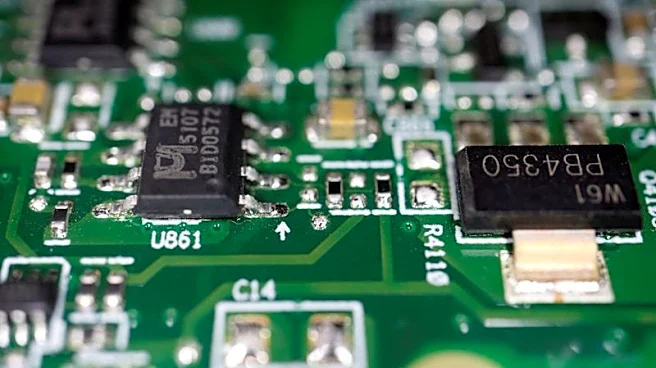
to amend Section 48D of the CHIPS and Science Act to cover semiconductor manufacturing in low Earth orbit. The bill is designed to encourage U.S. firms to develop microgravity chipmaking technology, thereby enhancing domestic competitiveness against international efforts, particularly from China. A companion bill in the House, led by Representatives Vern Buchanan, Terri Sewell, and Suzan DelBene, proposes to explicitly include 'semiconductor manufacturing facilities located in outer space' in the advanced manufacturing investment credit. This initiative is supported by research indicating that microgravity can improve the quality of semiconductor crystals, offering potential manufacturing advantages.
Why It's Important?
The introduction of the Semiconductor Superiority Act is significant as it represents a strategic move to bolster the U.S. semiconductor industry by leveraging the unique conditions of space. Microgravity environments have been shown to produce higher-quality semiconductor substrates, which could enhance the performance and reliability of chips. This development is crucial as the U.S. seeks to maintain its technological edge and reduce dependency on foreign semiconductor supply chains, particularly in light of China's advancements in orbital materials science. The bill also addresses national security concerns by potentially reducing the risk of supply chain disruptions and ensuring that critical technologies remain under U.S. control.
What's Next?
The proposed legislation will now proceed to the relevant committees in both the Senate and the House for hearings and markup. The success of the bill will depend on committee actions, budget evaluations, and the ability of the industry to demonstrate the practicality and scalability of orbital semiconductor fabrication. Lawmakers will need to address export-control and national-security issues associated with extending tax credits to space-based manufacturing. The White House and trade officials are likely to play a significant role in shaping the oversight and regulatory framework necessary to support this initiative.