
What's Happening?
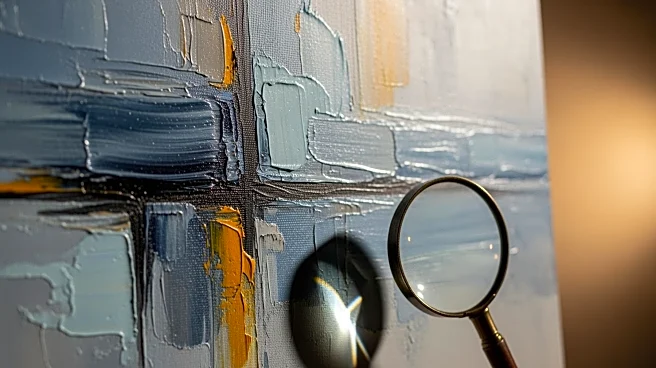
Patrick Quéré, an American cryptography enthusiast, claims to have discovered hidden codes in the paintings of 20th-century artist Nicolas de Staël. Quéré's interest began with a small painting, 'La Clé,'
allegedly gifted to his grandfather by de Staël. He asserts that the artist encrypted his name within the geometric patterns of his works, a theory he supports with findings in other paintings like 'Composition' and 'Parc des Princes.' Despite Quéré's claims, the art community remains skeptical, as 'La Clé' is not officially recognized in de Staël's catalogue raisonné. Quéré's theory suggests that de Staël's encryption period spanned from 1948 to 1953, adding a layer of mystery to the artist's already dramatic life story.
Why It's Important?
This claim, if validated, could alter the understanding of de Staël's artistic legacy, offering new insights into his creative process and personal expression. It highlights the potential for undiscovered elements in well-studied artworks, encouraging further exploration and analysis. The skepticism from the art community underscores the challenges faced by independent researchers in gaining recognition and support for unconventional theories. This case also raises questions about the authenticity and provenance of artworks, which are critical in the art market and historical scholarship.
Beyond the Headlines
Quéré's pursuit reflects broader themes of obsession and the quest for meaning in art, illustrating how personal narratives can intersect with historical figures. The story also touches on the role of amateur researchers in contributing to art history, challenging traditional academic boundaries. The potential discovery of hidden messages in de Staël's work could inspire similar investigations into other artists, possibly uncovering new dimensions of art history.