
What's Happening?
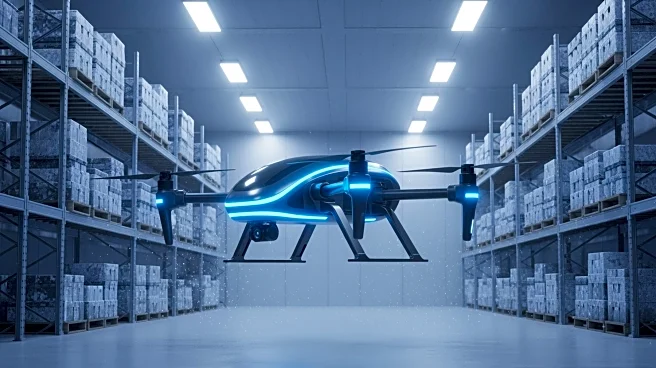
Corvus Robotics has launched the Corvus One for Cold Chain, an autonomous inventory management system designed to operate in freezer environments as cold as minus-20 degrees Fahrenheit. This system is engineered
to perform continuous inventory cycle counts without human intervention, providing real-time visibility and reducing the need for manual labor in harsh conditions. The Corvus One for Cold Chain uses industrial-grade barcode scanners to maintain performance despite frost and glare, and it stabilizes flight to adapt to airflow from freezer blowers and door activity. Kroger, a leading national grocer, is already utilizing this system in live operations, benefiting from consistent inventory visibility and reduced reliance on manual cycle counts.
Why It's Important?
The introduction of the Corvus One for Cold Chain represents a significant advancement in warehouse automation, particularly in environments that are challenging for human workers. By automating inventory management in sub-zero conditions, Corvus Robotics is addressing labor safety concerns and reducing operational costs associated with specialized gear and limited exposure windows. This technology allows for more accurate inventory management, reducing write-offs and improving replenishment accuracy. The system's ability to operate autonomously in extreme conditions could set a new standard for inventory management in the cold chain industry, potentially influencing other sectors that require similar environmental resilience.
What's Next?
As Corvus Robotics continues to deploy the Corvus One for Cold Chain, it is likely that more companies in the cold chain logistics sector will adopt this technology to enhance efficiency and safety. The system's success at Kroger could serve as a case study for other grocers and logistics companies considering similar automation solutions. Additionally, Corvus Robotics may explore further enhancements to the system's capabilities, such as expanding its operational range or integrating with other warehouse management systems. The broader adoption of such technology could lead to significant shifts in labor dynamics and operational strategies within the industry.