
What's Happening?
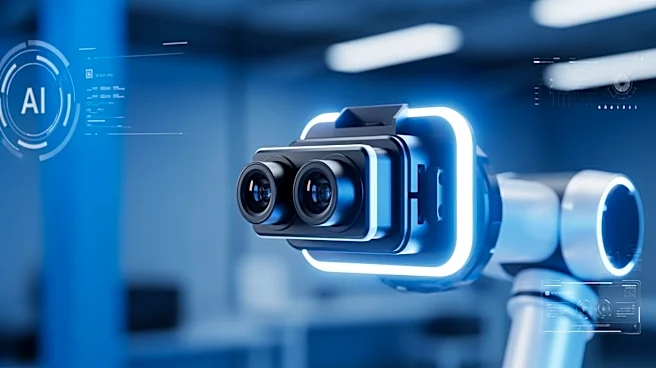
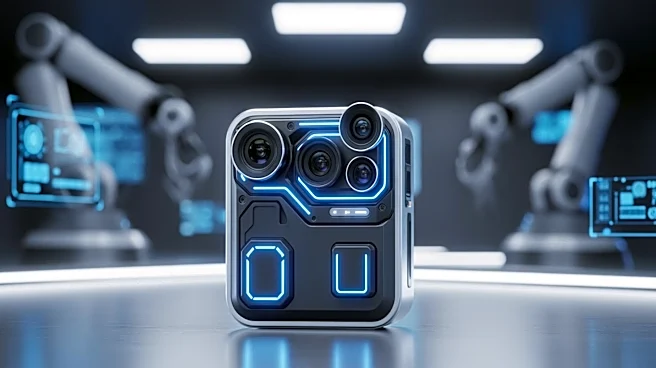
Ouster, Inc. has introduced the Stereolabs ZED X Nano, a compact wrist-mounted stereo camera designed to improve robotic manipulation, imitation learning, and high-throughput data collection. The camera is engineered
to address critical bottlenecks in RGB image quality and capture latency, which are essential for scaling imitation learning and reinforcement learning tasks. The ZED X Nano is 40% smaller in height compared to similar solutions and can be mounted directly onto robotic wrists and end-of-arm tooling. It features a 1920x1200 global shutter sensor capable of capturing high-resolution RGB and depth images at up to 120fps. This new product offers native integration with NVIDIA Isaac Sim and Isaac Lab for sim-to-real transfer, as well as support for ROS and ROS 2, enabling teams to capture high-fidelity demonstrations and deploy to hardware using the same sensor and software stack.
Why It's Important?
The release of the Stereolabs ZED X Nano camera is significant for the robotics industry as it provides a major upgrade to vision systems, allowing machines to sense, think, act, and learn with unprecedented precision. The camera's ability to capture high-quality, low-latency image data at the edge is crucial for the future of Physical AI. It offers advantages in grasp pose estimation, fine placement, and assembly tasks, where lateral error can lead to manipulation failure. The camera's durability, powered by a ruggedized GMSL2 connection, ensures reliability in the repeated motion and cable stress of robotic arms. This development is likely to enhance the capabilities of robotics teams working on imitation learning and reinforcement learning pipelines, potentially leading to more efficient and accurate robotic systems.
What's Next?
The ZED X Nano is available for pre-order, with shipping expected to begin in May 2026. As robotics teams integrate this new technology, it is anticipated that there will be increased adoption of the camera in various industrial and robotics applications. The enhanced capabilities provided by the ZED X Nano may lead to further innovations in robotic manipulation and data collection, potentially influencing the development of new AI models and perception software. Stakeholders in the robotics industry will likely monitor the impact of this technology on improving the efficiency and accuracy of robotic systems.