





What's Happening?
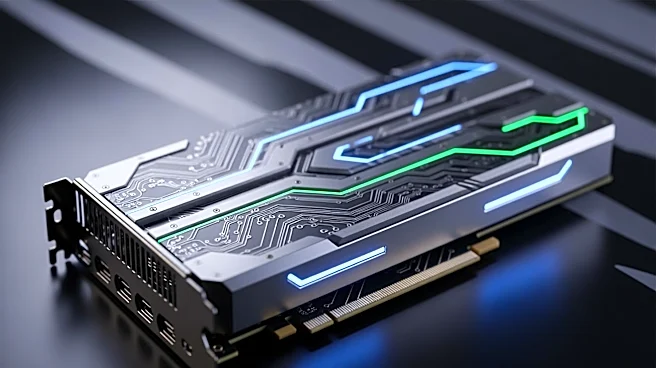
Intel's Big Battlemage Arc Pro B70 GPU has been benchmarked, revealing performance levels comparable to Nvidia's RTX 5060 Ti 16 GB. The Arc Pro B70, utilizing the Big Battlemage GPU, was initially designed for gaming but is now positioned as a cost-effective
option for running local AI models, priced at approximately $1,000. The benchmarks, conducted by PCGamesHardware, show that the B70 performs similarly to the RTX 5060 Ti in traditional raster gaming. However, it falls behind when ray tracing or path tracing is enabled. The GPU's large size and production cost, using a TSMC N5-class node, make it less competitive as a gaming GPU compared to Nvidia's more efficient and smaller chips.
Why It's Important?
The benchmarking results highlight Intel's challenges in competing with Nvidia in the gaming GPU market. While the Arc Pro B70 offers decent performance, its large size and production costs make it less viable as a gaming GPU. This development underscores Nvidia's efficiency in producing smaller, cost-effective chips that deliver competitive performance. For consumers and the gaming industry, this means Nvidia remains a dominant player, potentially influencing pricing and availability of high-performance GPUs. Intel's focus on AI applications for the B70 suggests a strategic pivot, which could impact the company's market positioning and future product development.
What's Next?
Intel's decision not to release the G31 as a gaming GPU suggests a shift in strategy towards AI and other applications. The company may focus on optimizing its GPUs for non-gaming uses, potentially exploring new markets and applications. For the gaming industry, Nvidia's continued dominance could lead to further innovations and competitive pricing strategies. Intel's future developments in GPU technology will be closely watched, as the company seeks to leverage its expertise in AI and other fields to remain competitive.
Beyond the Headlines
The benchmarking of Intel's Arc Pro B70 highlights broader industry trends, including the increasing importance of AI applications and the challenges of competing in the gaming GPU market. Intel's pivot towards AI reflects a growing demand for specialized computing power, which could drive future innovations in both hardware and software. Additionally, the efficiency of Nvidia's chip designs underscores the competitive pressures in the semiconductor industry, where size, cost, and performance are critical factors.