



What's Happening?
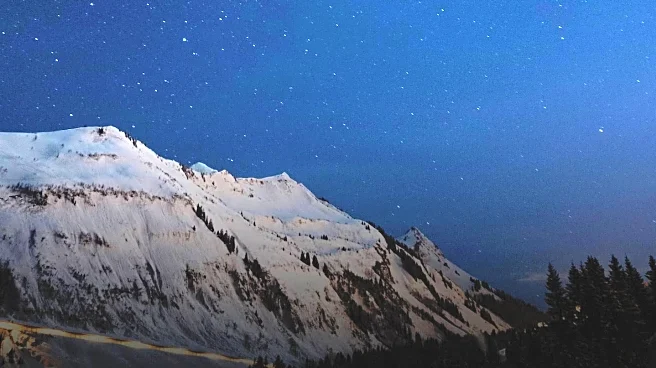
As the year 2025 draws to a close, the night sky is set to offer a series of captivating astronomical events. From December 20, 2025, to January 4, 2026, stargazers in the Northern Hemisphere can witness a variety of celestial phenomena. Highlights include the appearance of Jupiter as a bright 'Christmas Star', the Ursids meteor shower peaking on December 21-22, and a waxing crescent moon displaying 'Earthshine' from December 22-24. Additionally, the International Space Station will be visible on Christmas Eve, resembling 'Santa's sleigh' as it crosses the sky. The Christmas Tree Cluster, a young star cluster, will also be visible for those with telescopes. Other notable events include the conjunction of Saturn and the moon on December 26, the close encounter
of the Pleiades and the moon on New Year's Eve, and the rise of a full Wolf Supermoon on January 3, 2026.
Why It's Important?
These astronomical events provide a unique opportunity for both amateur and seasoned astronomers to engage with the night sky. The visibility of Jupiter, Saturn, and the Pleiades offers educational opportunities for learning about our solar system and beyond. Meteor showers like the Ursids and Quadrantids provide a natural spectacle that can inspire interest in science and astronomy. The events also offer a chance for astrophotography enthusiasts to capture stunning images of the night sky. Moreover, these celestial occurrences can foster a sense of wonder and curiosity about the universe, encouraging public interest in space exploration and science education.
What's Next?
As these events unfold, astronomy clubs and educational institutions may organize viewing parties and workshops to engage the public. The visibility of the International Space Station on Christmas Eve could lead to increased interest in space missions and the work of NASA. Additionally, the upcoming Quadrantids meteor shower in early January 2026, despite challenging viewing conditions due to moonlight, will still attract those eager to catch a glimpse of shooting stars. These events may also prompt discussions on the importance of preserving dark skies and reducing light pollution to enhance stargazing experiences.