






What's Happening?
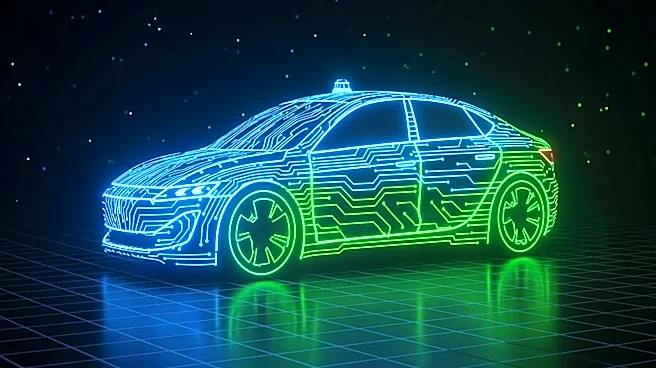
NVIDIA has launched Cosmos 3, a groundbreaking open physical AI foundation model designed to enhance physical AI reasoning, world simulation, and action generation. This model is built on a mixture-of-transformers architecture, enabling it to understand
and generate text, images, video, ambient sound, and actions with high physics accuracy. The launch also includes the formation of the NVIDIA Cosmos Coalition, a collaboration with leading AI labs and robotics companies such as Agile Robots, Black Forest Labs, and Skild AI. Cosmos 3 aims to reduce training and evaluation cycles for physical AI from months to days, providing developers with a powerful tool for building robots, autonomous vehicles, and vision AI systems. The model is trained on a vast multimodal dataset, offering a robust foundation for physical AI systems with less data and lower training costs.
Why It's Important?
The introduction of Cosmos 3 represents a significant advancement in the field of physical AI, potentially transforming industries reliant on robotics and autonomous systems. By reducing the time and resources needed for training AI models, NVIDIA's Cosmos 3 could accelerate the development of more sophisticated and capable AI systems. This has implications for sectors such as manufacturing, transportation, and healthcare, where AI-driven automation can lead to increased efficiency and innovation. The collaboration through the Cosmos Coalition further enhances the potential for rapid advancements in AI technology, fostering an ecosystem of shared research and development that could lead to breakthroughs in AI applications across various industries.
What's Next?
With the availability of Cosmos 3 Super and Cosmos 3 Nano, developers can begin utilizing these models for post-training robotics and autonomous vehicle applications. The upcoming release of Cosmos 3 Edge will enable real-time inference at the edge, expanding the model's applicability in dynamic environments. Developers can access and customize Cosmos 3 models through platforms like Hugging Face and GitHub, facilitating the deployment of AI systems as microservices. The ongoing collaboration within the Cosmos Coalition is expected to drive further innovation and interoperability in physical AI, potentially leading to new applications and enhancements in AI-driven technologies.
Beyond the Headlines
The launch of Cosmos 3 not only advances technical capabilities but also raises ethical and regulatory considerations in AI development. As AI systems become more integrated into everyday life, ensuring their safe and ethical deployment becomes crucial. The collaboration within the Cosmos Coalition may also influence industry standards and practices, promoting responsible AI development. Additionally, the model's ability to simulate and predict physical environments could lead to new insights in fields like environmental science and urban planning, offering tools for addressing complex challenges through AI-driven solutions.