







What's Happening?
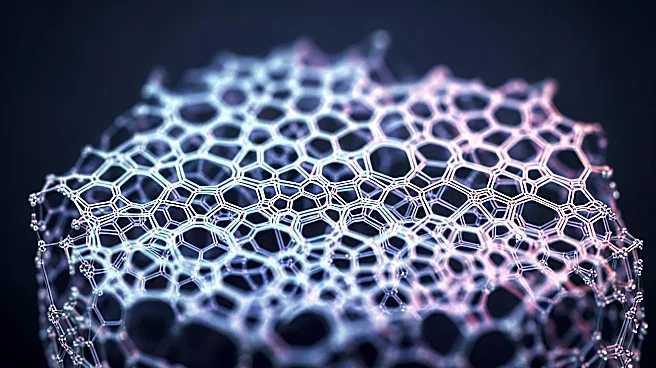
Researchers have developed ImpCarv, a novel technique for creating three-dimensional nanoscale metastructures with precise refractive index distributions. This method uses patterned vacancies and isotropic hydrogel shrinkage to fabricate visible-light
photonic crystals and other nanophotonic applications. ImpCarv overcomes limitations of traditional optical nanofabrication by achieving sub-100 nm features, enabling advanced functionalities like structural color and optical computing. The process involves creating a hydrogel scaffold, photopatterning vacancies, and shrinking the structure to achieve high-resolution features.
Why It's Important?
ImpCarv represents a significant advancement in optical nanofabrication, offering unprecedented control over 3D refractive-index distributions. This capability could revolutionize the design of photonic devices, metastructures, and all-optical computing systems. The technique's ability to create complex nanophotonic structures with high precision opens new possibilities for applications in photonics, quantum optics, and optical information processing. The development of such technologies could lead to more efficient and compact optical devices, impacting industries ranging from telecommunications to computing.
Beyond the Headlines
The ImpCarv technique could pave the way for integrating metallic or functional materials into nanophotonic structures, further expanding their capabilities. This approach may lead to the development of new optical devices and metasurfaces with enhanced performance and functionality. The ability to precisely control light at the nanoscale could also have implications for quantum computing and other emerging technologies. As researchers continue to explore the potential of ImpCarv, it may become a foundational tool in the field of nanophotonics.