
What's Happening?
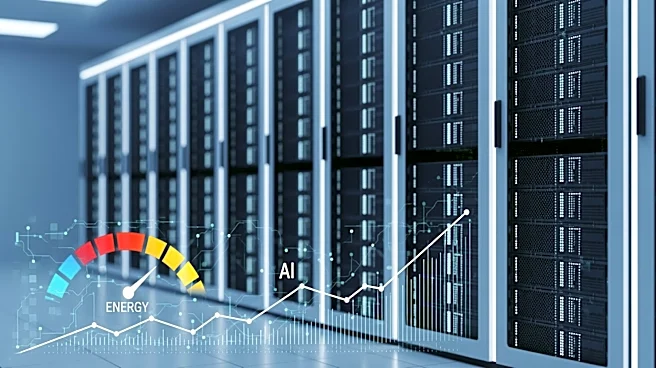
The rapid expansion of artificial intelligence infrastructure is leading to unprecedented demand for electricity and other resources. As AI workloads become increasingly power-intensive, global electricity consumption
from data centers is expected to rise sharply over the next decade. In the United States, utilities are struggling to accommodate simultaneous growth from data centers, electrification, manufacturing expansion, and population growth. This situation is prompting major technology companies to rethink their energy procurement strategies, seeking direct access to generation through long-term power purchase agreements, renewable energy projects, and nuclear energy partnerships. The availability of reliable and affordable electricity is becoming a competitive advantage, with companies that secure it poised to expand faster than those awaiting transmission upgrades or new generation capacity.
Why It's Important?
The growing demand for energy due to AI infrastructure expansion is reshaping the energy sector. Utilities are increasing capital expenditures, transmission developers are proposing major grid expansions, and independent power producers are evaluating new generation projects. This demand is arriving at a time when power systems are already under pressure from transportation electrification, industrial reshoring, and population growth. The competition for power is intensifying, with data centers, manufacturers, utilities, and consumers vying for the same resources. Additionally, large data centers require substantial cooling capacity, creating new pressures on local water systems. These challenges are influencing corporate sustainability strategies, as technology companies reassess how quickly carbon-free power can be deployed at scale.
What's Next?
As the demand for AI infrastructure continues to grow, the energy sector is likely to see increased investment and development. Utilities, natural gas producers, pipeline operators, power developers, nuclear companies, transmission providers, and water infrastructure firms are becoming increasingly important participants in the AI economy. Policymakers and regulators will need to balance economic development opportunities against long-term resource constraints, ensuring that infrastructure development can keep pace with demand. The future of AI may depend not only on software breakthroughs but also on the ability of the energy system to expand rapidly enough to support it.
Beyond the Headlines
The AI boom is often framed as a competition for computing power, but it is increasingly becoming a competition for energy, water, and infrastructure. The infrastructure required to power AI could generate investment opportunities across sectors traditionally viewed as separate from technology. As data center demand accelerates, utilities, power producers, natural gas suppliers, nuclear operators, transmission companies, and infrastructure providers may become some of the biggest beneficiaries. The digital revolution is creating demand not only for computing power but also for the physical systems required to support it.