


What's Happening?
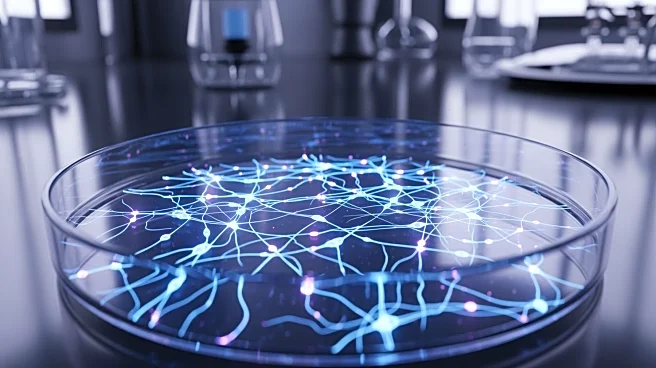
Cortical Labs, an Australian biotech startup, has made significant strides in biological computing by teaching human brain cells to play the video game Doom. This development follows their previous success in 2022, where they taught 'mini-brains' to play Pong.
The company has now advanced to a more complex game environment, showcasing the adaptability of neural cultures. By mapping the game's video feed into electrical stimulation patterns, the neurons were able to interact with the game, albeit with limited proficiency. This experiment highlights the potential of biological materials in processing information in ways that silicon-based chips cannot.
Why It's Important?
This breakthrough in biological computing could have far-reaching implications for technology and neuroscience. By demonstrating that human brain cells can interact with complex digital environments, Cortical Labs is paving the way for new forms of computing that leverage biological processes. This could lead to advancements in artificial intelligence, robotics, and even medical technologies that require adaptive learning and decision-making capabilities. The ability to use biological materials for computing tasks could revolutionize industries that rely on complex data processing and real-time learning.
What's Next?
Cortical Labs plans to further refine their technology, aiming to improve the proficiency of the neurons in playing Doom and tackling even more complex tasks. This could involve enhancing the interface between digital and biological systems, potentially leading to applications in controlling robotic systems or developing new AI models. The company’s ongoing research may attract interest from tech companies and research institutions looking to explore the intersection of biology and computing.
Beyond the Headlines
The ethical implications of using human brain cells in computing are significant. As this technology develops, questions about the consciousness and rights of these biological systems may arise. Additionally, the potential for misuse in surveillance or military applications could spark debates about regulation and oversight. The cultural impact of integrating biological computing into everyday technology could also shift societal perceptions of intelligence and machine learning.