








What's Happening?
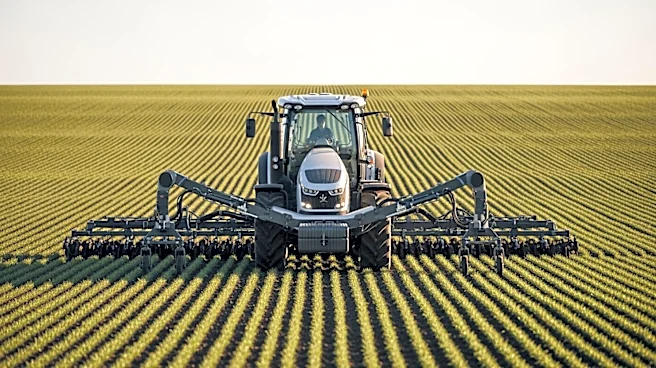
A Kentucky farmer, Quint Pottinger, has made history by planting an entire crop using a driverless tractor. This innovative approach has allowed Pottinger to significantly increase his planting efficiency, achieving close to 100 acres a day with an eight-row
planter, compared to 60-70 acres a day with a 16-row planter. The autonomous tractor operates 20 hours a day, reducing labor costs and maximizing productivity. This development is part of a broader trend in precision agriculture, where technology such as drones and AI are transforming farming operations. Farmers in Nebraska are also adopting precision technologies like John Deere See & Spray and AutoPath to streamline their operations.
Why It's Important?
The use of autonomous technology in agriculture represents a significant shift towards more efficient and sustainable farming practices. By reducing labor costs and increasing productivity, farmers can better manage resources and improve crop yields. This technological advancement is crucial as the agricultural sector faces challenges such as labor shortages and the need for increased food production. The integration of precision technologies can lead to more informed decision-making, ultimately benefiting both farmers and consumers by ensuring a stable food supply and potentially lowering food costs.
What's Next?
As autonomous technology continues to evolve, more farmers are likely to adopt these innovations to enhance their operations. The success of Pottinger's autonomous planting could encourage other farmers to invest in similar technologies, leading to widespread changes in agricultural practices. Additionally, ongoing advancements in AI and robotics may further improve the efficiency and accuracy of farming operations, paving the way for a future where autonomous systems play a central role in agriculture.