
What's Happening?
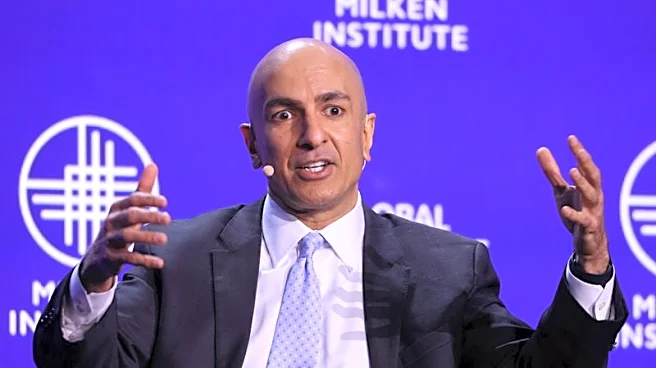
A Federal Reserve official has expressed dissent regarding the Federal Open Market Committee's (FOMC) decision to include forward guidance in its policy statement. The official supported the decision to hold
the federal funds rate steady but opposed the language suggesting potential future rate cuts. This dissent arises from concerns over the appropriateness of such guidance given the current economic and geopolitical uncertainties. The official argues that the FOMC should maintain flexibility, indicating that future rate changes could be either cuts or hikes, depending on economic developments. The dissent highlights the ongoing debate within the FOMC about the best approach to monetary policy amid fluctuating inflation rates and labor market conditions.
Why It's Important?
The dissent within the FOMC underscores the challenges faced by the Federal Reserve in navigating monetary policy during uncertain times. The inclusion of forward guidance can significantly influence financial conditions, potentially impacting inflation and employment targets. The debate reflects broader concerns about the balance between providing market clarity and maintaining policy flexibility. The outcome of this debate could affect interest rates, borrowing costs, and economic growth, influencing businesses and consumers across the U.S. The decision also has implications for the Fed's credibility and its ability to manage inflation expectations effectively.
What's Next?
The FOMC will continue to monitor economic indicators and geopolitical developments to determine the appropriate course of action. The ongoing conflict in the Middle East and its impact on oil prices and inflation will be key factors in future policy decisions. The Fed may need to adjust its stance if inflation expectations become unanchored or if the labor market shows signs of significant weakening. Stakeholders, including businesses and investors, will be closely watching for any shifts in the Fed's policy outlook, which could signal changes in interest rates and financial conditions.
Beyond the Headlines
The dissent highlights the complexities of using forward guidance as a monetary policy tool. While it can provide clarity to markets, it also risks limiting the Fed's flexibility in responding to unforeseen economic changes. The situation raises questions about the effectiveness of forward guidance in achieving the Fed's dual mandate of stable prices and maximum employment. Additionally, the geopolitical context, particularly the conflict in the Middle East, adds layers of uncertainty that complicate the Fed's decision-making process. The long-term implications of these dynamics could shape the Fed's approach to policy communication and its role in stabilizing the economy.