


What's Happening?
An international team of scientists has revived Thomas Edison's early 20th-century concept of a nickel-iron battery, which could potentially revolutionize renewable energy storage. Originally, Edison believed that this type of battery could extend the
range of electric vehicles to 100 miles, compared to the 30 miles offered by lead-acid batteries at the time. The modern iteration of this battery uses a novel approach inspired by natural processes, such as how shellfish form their shells. The researchers used beef byproduct proteins and graphene oxide to create a scaffolding, onto which nickel and iron clusters were grown. This structure was then superheated and baked, resulting in a carbon aerogel that allows for rapid recharging and a long lifespan. The prototype battery can recharge in seconds and endure over 12,000 cycles, equivalent to about 30 years of daily use.
Why It's Important?
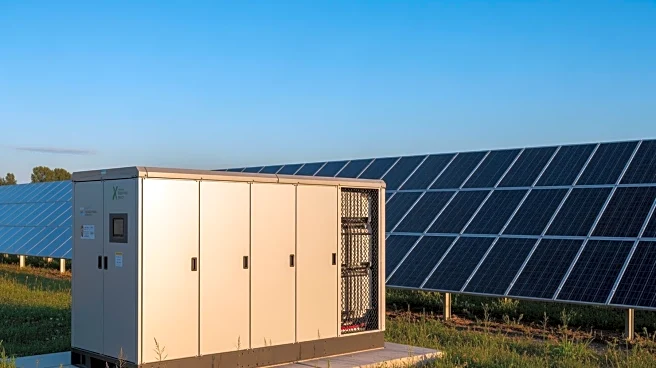
The revival of Edison's battery design is significant as it offers a potential solution for storing excess electricity generated by renewable energy sources like solar farms. While the storage capacity of the prototype is currently lower than that of lithium-ion batteries, its rapid recharging capability and long lifespan make it a promising candidate for energy storage applications. This development could help address one of the major challenges in the renewable energy sector: efficient and sustainable energy storage. By improving storage solutions, the reliance on fossil fuels could be reduced, contributing to a decrease in carbon emissions and advancing global efforts to combat climate change.
What's Next?
The research team will likely focus on improving the storage capacity of the nickel-iron battery to make it more competitive with existing lithium-ion technology. Further development and testing are needed to determine the feasibility of scaling up production for commercial use. If successful, this battery could be integrated into renewable energy systems, providing a more sustainable and efficient way to store energy. Stakeholders in the renewable energy industry, including solar and wind farm operators, may take interest in this technology as a means to enhance their energy storage capabilities.