




What's Happening?
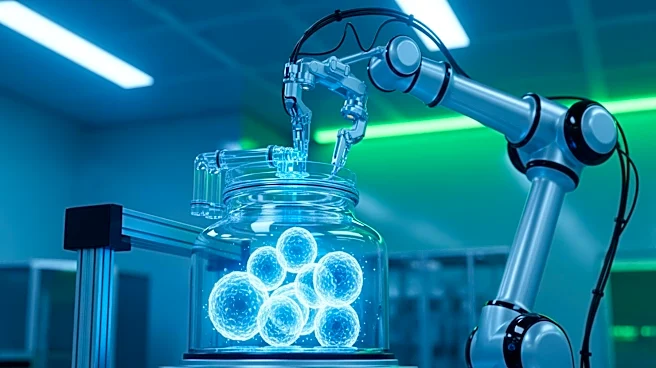
Generalist AI has unveiled its new robotics model, GEN-1, which represents a significant advancement in general-purpose artificial intelligence for physical tasks. The GEN-1 model is designed as an 'embodied foundation model' capable of perceiving, reasoning,
and acting in the physical world. It achieves a 99 percent success rate on certain tasks, compared to 64 percent for its predecessor, and completes tasks up to three times faster. The model is highly data-efficient, requiring only one hour of robot-specific data to adapt to new tasks. Unlike traditional industrial robots, GEN-1 operates in dynamic settings by integrating perception, decision-making, and motion into a single system.
Why It's Important?
The introduction of the GEN-1 model by Generalist AI marks a pivotal moment in the development of robotics and artificial intelligence. By achieving high success rates and efficiency, GEN-1 has the potential to transform industries reliant on automation, such as manufacturing and logistics. The model's ability to adapt to dynamic environments and perform tasks with minimal errors could lead to increased productivity and reduced operational costs. This advancement also reflects a broader trend towards 'physical AI' systems that aim to move beyond narrowly defined automation, offering more adaptable and learning-based approaches for real-world applications.
What's Next?
Generalist AI has made early access to the GEN-1 model available to selected partners, indicating ongoing development and refinement of the platform. As the model continues to evolve, further improvements in speed and reliability are anticipated, which could lead to broader deployment across various industries. The company acknowledges that not all tasks currently reach production-level performance, suggesting that continued research and development will be necessary to fully realize the model's potential. Stakeholders in the robotics and AI sectors will be watching closely to see how GEN-1 influences future innovations and applications.