





What's Happening?
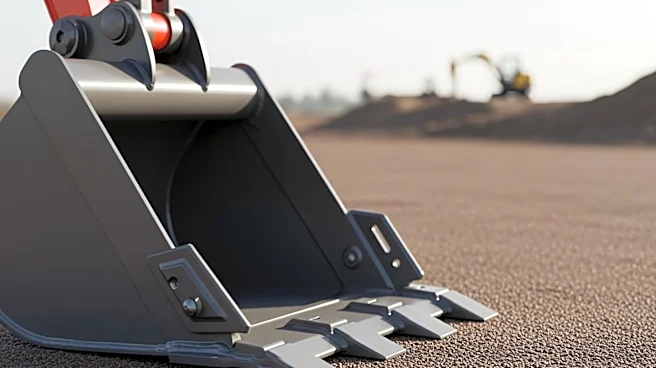
Wacker Neuson has introduced a new line of 2-tonne mini-excavators, including models ET18, ET20, and ET25, designed to deliver high performance across various applications. These excavators feature parallel auxiliary control circuits, allowing operators
to perform multiple tasks simultaneously with ease. The compact design, with track widths starting at 990 millimeters for the ET18 and ET20, and 1,100 millimeters for the ET25, makes them ideal for confined spaces and sensitive sites. The models incorporate control technology from larger excavators, providing intuitive and responsive handling for precision digging. Additionally, the optional Vertical Digging System (VDS) enhances versatility on uneven terrain by allowing continuous tilting of the upper carriage for accurate vertical positioning.
Why It's Important?
The launch of these mini-excavators is significant for the construction and landscaping industries, where precision and adaptability are crucial. The ability to perform complex operations smoothly and efficiently can lead to increased productivity and reduced operational costs. The compact size and advanced control systems make these excavators suitable for urban environments and projects with limited space, potentially expanding their market reach. The integration of features like the VDS and quick-change function for attachments further enhances their utility, offering a competitive edge in the equipment market.
What's Next?
As these mini-excavators enter the market, construction and landscaping companies may evaluate their current equipment fleets to consider upgrades or replacements. The focus on precision and versatility could drive demand in urban development projects and areas with challenging terrain. Wacker Neuson may continue to innovate and expand its product line to meet evolving industry needs, potentially influencing competitors to enhance their offerings as well.
Beyond the Headlines
The introduction of these advanced mini-excavators highlights a trend towards more efficient and environmentally friendly construction equipment. As industries increasingly prioritize sustainability, the demand for compact, versatile machinery that minimizes environmental impact is likely to grow. This shift could lead to broader adoption of similar technologies across various sectors, promoting innovation and sustainability in construction practices.