
What's Happening?
In a thrilling NCAA Division I men's basketball game, the Alabama Crimson Tide narrowly defeated the Arkansas Razorbacks with a final score of 117-115 in double overtime. The game, held on February 18, 2026, saw Alabama ranked 25th and Arkansas ranked 20th,
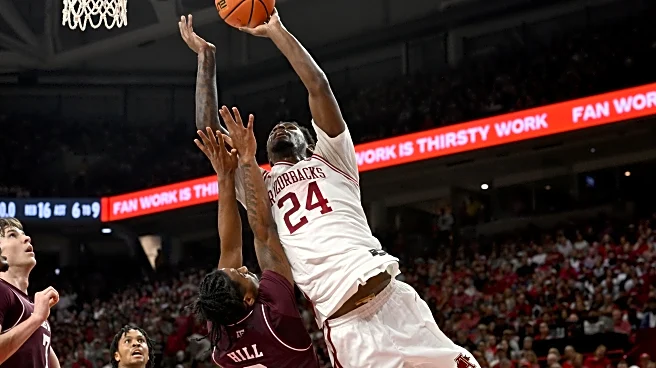
showcasing a high-stakes matchup between two competitive teams. Houston Mallette of Alabama made a crucial 3-pointer with just 51 seconds left in the second overtime, securing the victory for his team. Despite a standout performance by Arkansas' Darius Acuff Jr., who scored 49 points, Alabama managed to hold on for the win. The game was marked by intense back-and-forth action, with both teams displaying strong offensive capabilities. Alabama's victory was a significant achievement, given the formidable challenge posed by Arkansas.
Why It's Important?
This victory is significant for Alabama as it strengthens their position in the Southeastern Conference standings, where they are closely competing with other top teams like Florida and Arkansas. The win not only boosts Alabama's morale but also enhances their prospects for a favorable seeding in the upcoming NCAA tournament. For Arkansas, the loss is a setback in their pursuit of a higher conference ranking, but the close scoreline and strong individual performances indicate their potential to bounce back in future games. The match also highlights the competitive nature of college basketball, where rankings can shift rapidly based on game outcomes, impacting team strategies and player performances.
What's Next?
Following this game, both Alabama and Arkansas will continue their respective seasons with an eye on improving their standings in the Southeastern Conference. Alabama will aim to build on this victory to secure a higher seed in the NCAA tournament, while Arkansas will look to regroup and address any weaknesses exposed during the game. Both teams are expected to analyze this match closely to refine their strategies and enhance their performance in upcoming games. The outcome of this game could influence future matchups, as teams adjust their tactics based on the strengths and weaknesses observed.