

What's Happening?
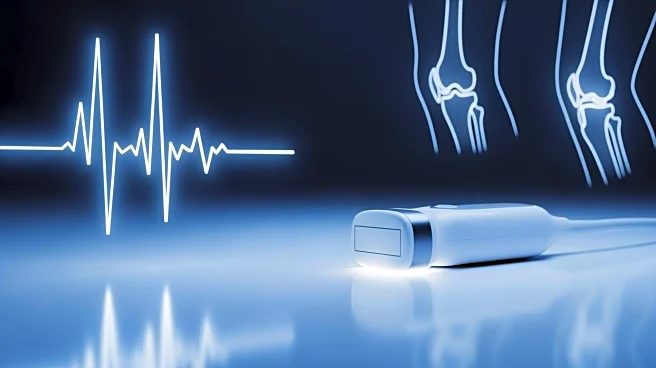
Clarius Mobile Health has launched T-Mode Heart and T-Mode Knee as part of its Clarius App 12.2.6 update. These tools are designed to enhance handheld point-of-care ultrasound (POCUS) devices by providing AI-guided training. The T-Mode feature acts as a real-time
translation layer, offering a split-screen view during live exams. One side displays the standard grayscale ultrasound, while the other shows an AI-generated, color-coded, and labeled image of the same anatomy. This innovation aims to assist primary care physicians (PCPs) in interpreting complex anatomical images, such as those of the heart, which typically require specialized training. T-Mode Heart helps users identify heart chambers and valves, crucial for screening heart failure. T-Mode Knee addresses common primary care complaints like knee pain by helping clinicians identify anatomical markers for accurate referrals.
Why It's Important?
The introduction of T-Mode by Clarius Mobile Health is significant as it democratizes access to advanced diagnostic tools in primary care settings. By enabling PCPs to accurately interpret ultrasound images, the technology can lead to earlier diagnosis of conditions like heart failure, potentially reducing the burden on specialists and improving patient outcomes. The ability to screen for heart conditions or assess knee pain more effectively can streamline patient care, reduce unnecessary referrals, and shorten wait times for specialist consultations. This advancement could lead to cost savings in healthcare and improve the efficiency of primary care services.
What's Next?
As Clarius Mobile Health continues to roll out T-Mode, the adoption of AI-powered ultrasound training in primary care is expected to grow. This could lead to further developments in AI applications for other anatomical areas, expanding the scope of POCUS devices. The healthcare industry may see increased investment in similar technologies, prompting further innovation. Additionally, training programs for PCPs may incorporate these tools, enhancing their diagnostic capabilities. Stakeholders, including healthcare providers and technology developers, will likely monitor the impact of T-Mode on patient care and healthcare costs.