
What's Happening?
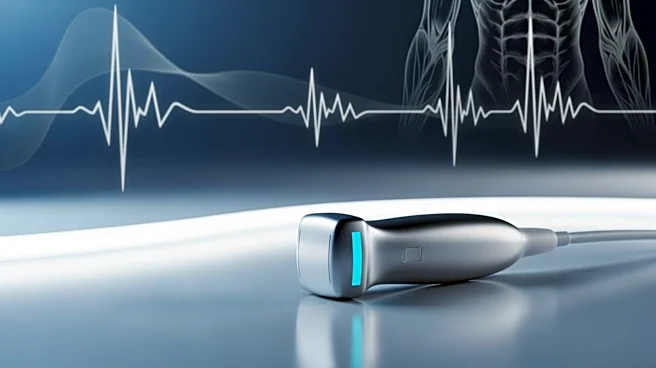
RIVANNA, a developer of AI-enabled clinical decision-support solutions, has received 510(k) clearance from the U.S. Food and Drug Administration (FDA) for its Accuro XV Diagnostic Ultrasound System. This
clearance allows the system to be used commercially for musculoskeletal imaging by qualified healthcare professionals in hospitals and medical clinics. The Accuro XV system features advanced AI capabilities, including BoneEnhance for improved bone visualization and CADe/x for automated fracture detection. These capabilities are being validated through a multi-site clinical study across eight academic medical centers. The system is designed to automate large field-of-view image acquisition and includes features such as a touchscreen interface and DICOM-compatible image archival workflows. The clearance follows a feasibility study showing that non-physician operators can acquire diagnostic-quality images with minimal training.
Why It's Important?
The FDA clearance of the Accuro XV system is significant as it represents a major advancement in musculoskeletal imaging technology. By integrating AI capabilities, the system aims to democratize access to high-quality imaging, potentially reducing the burden on imaging resources in emergency settings. This development could streamline emergency department workflows, expedite the evaluation of extremity injuries, and decrease reliance on X-ray referrals. The system's ability to provide consistent imaging quality across different operator experience levels could transform musculoskeletal injury care, supporting broader emergency preparedness objectives. The clearance also underscores the scalability of RIVANNA's platform, which could set a new standard of care in extremity injury triage.
What's Next?
With FDA clearance, RIVANNA plans to accelerate the development of AI capabilities for the Accuro XV system to unlock its full diagnostic potential. The company aims to enhance the system's fracture detection capabilities and expand its use in high-volume emergency settings. As the system becomes more widely adopted, it may influence clinical practices by providing a reliable, non-invasive imaging alternative to traditional methods. The ongoing clinical study will continue to validate the system's effectiveness, potentially leading to further innovations in AI-enabled medical imaging.