







What's Happening?
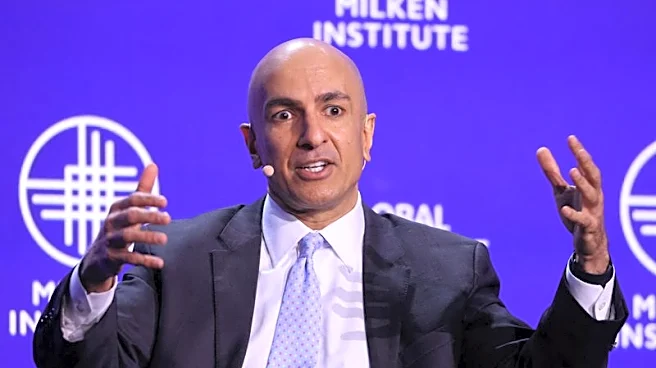
Austan Goolsbee, President of the Federal Reserve Bank of Chicago, has expressed concerns over the persistent nature of energy inflation, which has been exacerbated by the ongoing conflict in Iran. Speaking at the Bank of Japan-IMES Conference, Goolsbee noted
that initial market forecasts underestimated the duration and impact of elevated energy prices. Despite recent declines, oil prices remain significantly higher than pre-conflict levels, with Brent crude futures at $96 per barrel and West Texas Intermediate at $90.21 per barrel. Goolsbee highlighted the 'stagflationary shock' this situation poses to Asian economies, which are heavily reliant on energy imports. He also reflected on his decision to dissent from the Federal Reserve's final rate cut in 2025, citing the need for more evidence that inflation would not be persistent.
Why It's Important?
The persistence of energy inflation has significant implications for global and U.S. economic stability. For Asian economies, which are major energy importers, the continued high prices could lead to stagflation, characterized by slow economic growth and high inflation. This scenario could affect global supply chains and trade dynamics, potentially impacting U.S. businesses that rely on Asian markets. Domestically, the Federal Reserve's approach to interest rates is crucial, as prolonged inflation could necessitate further monetary policy adjustments. Goolsbee's comments underscore the challenges central banks face in balancing inflation control with economic growth, particularly in a volatile geopolitical environment.
What's Next?
The trajectory of energy prices will likely depend on geopolitical developments, particularly in the Middle East. Any progress in U.S.-Iran peace talks could lead to a stabilization of oil prices, potentially easing inflationary pressures. However, if tensions persist, central banks, including the Federal Reserve, may need to reassess their monetary policies to address ongoing inflation. Stakeholders in the energy sector and import-dependent industries will be closely monitoring these developments, as they could influence investment decisions and economic forecasts.