







What's Happening?
XCENA, a startup with offices in South Korea and the U.S., has raised $135 million in a Series B funding round, valuing the company at $570 million. The company aims to address inefficiencies in AI data processing by developing a chip that integrates
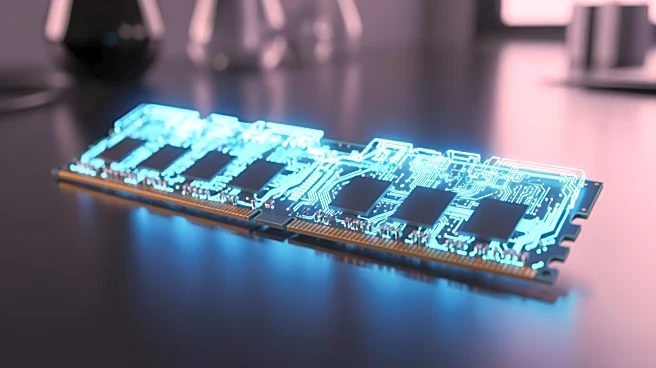
compute capabilities closer to DRAM memory. This innovation is expected to reduce the costly data relay between CPUs, GPUs, and memory, potentially lowering AI infrastructure costs. The MX1 chip, currently in prototype, is designed to handle data operations within the memory module, which could significantly enhance efficiency for hyperscalers investing heavily in AI infrastructure.
Why It's Important?
The development of XCENA's chip technology could have significant implications for the AI industry, particularly in reducing operational costs for companies that rely on AI infrastructure. By addressing the memory bottleneck, XCENA's solution could lead to more efficient data processing, which is crucial as AI applications become more complex and data-intensive. This could benefit large-scale AI users, such as tech giants and data centers, by providing cost savings and improved performance. The investment reflects a growing interest in memory-centric architectures as a means to enhance AI capabilities.
What's Next?
XCENA plans to begin mass production of its MX1 chip by the end of 2026, with revenue generation expected to start in 2027. The company is in early discussions with global memory vendors to expand its market reach. As the chip moves from prototype to production, it will be crucial to see how it performs at scale and whether it can deliver the promised efficiency gains. The success of this technology could influence future investments in AI infrastructure and drive further innovation in memory solutions.