





What's Happening?
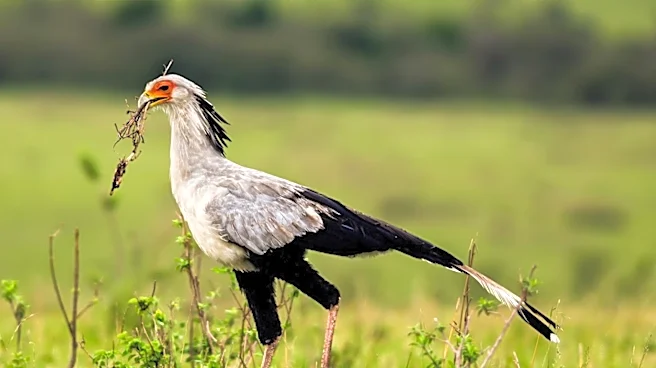
The secretary bird, a unique predator found in sub-Saharan Africa, employs an unusual hunting strategy by using powerful kicks to kill snakes, including cobras. Unlike typical birds of prey that rely on talons or beaks, the secretary bird uses its long
legs to deliver rapid, forceful kicks aimed at the snake's head. This method allows the bird to maintain a safe distance from its venomous prey. A 2016 study published in Current Biology quantified the bird's striking power, revealing that its kicks can exert a force five times its body weight. This adaptation is a response to the open grassland habitats where the bird lives, requiring visibility and mobility over stealth.
Why It's Important?
The secretary bird's hunting technique highlights the diverse adaptations in the animal kingdom, driven by environmental pressures and survival needs. Its ability to neutralize dangerous prey with precision and speed underscores the evolutionary arms race between predators and prey. This behavior not only fascinates biologists but also provides insights into the ecological dynamics of grassland ecosystems. Understanding such unique adaptations can inform conservation strategies, particularly in regions where habitat changes threaten species survival. The secretary bird's strategy exemplifies how species evolve specialized traits to thrive in specific environments, contributing to biodiversity and ecological balance.
Beyond the Headlines
The secretary bird's evolutionary path reflects the complex interplay between ecological opportunities and constraints. Its long legs, while advantageous for striking, also pose challenges in neural transmission, requiring precise coordination between visual and neuromuscular systems. This adaptation underscores the intricate balance of evolutionary trade-offs. The bird's reliance on kicking rather than traditional raptor methods illustrates how extreme environments can drive the development of novel survival strategies. As habitats continue to change due to human activities, studying such adaptations becomes increasingly important for predicting and mitigating impacts on wildlife.