


What's Happening?
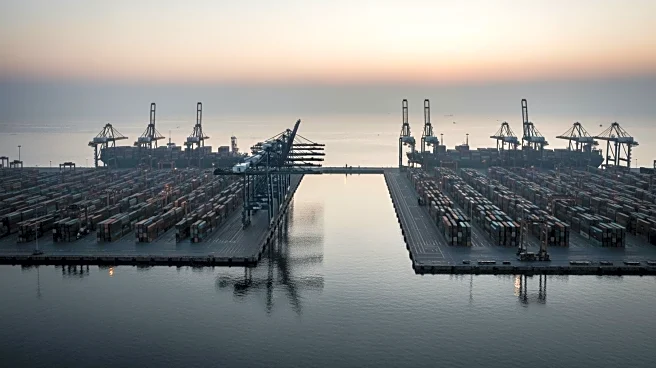
The Port of Los Angeles (POLA) and the Port of Long Beach (POLB) have reported a decline in their January 2026 volumes, marking a continuation of the downward trend observed in December 2025. POLA's volume fell by 12% annually to 812,000 TEU (Twenty-Foot
Equivalent Units), with imports and exports decreasing by 13% and 8% respectively. Similarly, POLB experienced an 11% annual decline in volume, although it still recorded the highest volume of any U.S. port in January. The decline is attributed to several factors, including the comparison to elevated numbers from the previous year when importers rushed to bring in cargo ahead of anticipated tariffs. Additionally, inventories remain high due to earlier surges, and U.S. trade policy continues to create uncertainty. Despite these challenges, consumer demand remains strong, and future purchase orders to Asia appear stable.
Why It's Important?
The decline in port volumes at POLA and POLB is significant as it reflects broader trends in U.S. trade and economic activity. The ports are critical gateways for international trade, and their performance is a barometer for the health of the global supply chain. The ongoing uncertainty surrounding U.S. trade policy, particularly tariffs, continues to impact shipping and logistics strategies. Retailers and shippers are cautious, affecting inventory levels and import patterns. The recent U.S. Supreme Court ruling on the unconstitutionality of certain tariffs adds another layer of complexity, as businesses and consumers await clarity on potential refunds and price adjustments. The situation underscores the interconnectedness of trade policy, consumer behavior, and economic performance.
What's Next?
Looking ahead, the ports anticipate continued uncertainty in the global supply chain due to unresolved trade policy issues. The POLB CEO has indicated that despite the current challenges, the port expects a strong year in 2026, projecting a volume of 9.5 million TEU, which would rank among its top five busiest years. However, the industry remains on edge as stakeholders seek clarity on tariff-related issues and potential refunds. The ports will continue to monitor consumer demand and adjust their operations accordingly. The outcome of ongoing trade negotiations and policy decisions will be crucial in shaping the future landscape of U.S. maritime trade.