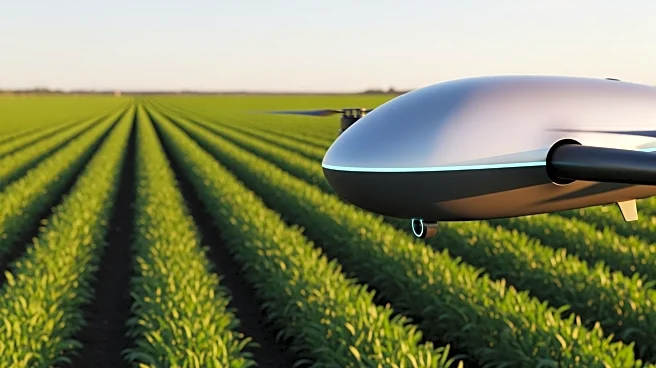

What's Happening?
The global AI in agriculture market is anticipated to grow significantly, reaching USD 15.90 billion by 2032, up from USD 2,567.54 million in 2024. This growth is driven by the increasing need for enhanced
food security and the adoption of precision farming techniques. The market is expected to expand at a compound annual growth rate (CAGR) of 25.60% from 2025 to 2032. Key factors contributing to this growth include the digitalization of agricultural practices, the need to combat labor shortages, and climate volatility. Governments, particularly in the Asia-Pacific region, are supporting this transformation through subsidies and digital agriculture frameworks. Major players in the market, such as Deere & Company and Bayer AG, are investing in AI technologies to improve crop yields and operational efficiency.
Why It's Important?
The expansion of AI in agriculture is crucial for addressing global food security challenges. As the global population grows and arable land becomes limited, AI technologies can optimize resource use, reduce waste, and ensure stable food supplies. The adoption of precision agriculture practices allows for more efficient management of water, fertilizers, and pesticides, which is essential for sustainable farming. Additionally, AI-driven automation can help overcome labor shortages and reduce operational costs, making agriculture more resilient to economic and environmental pressures. This technological shift is expected to benefit farmers, agribusinesses, and consumers by improving productivity and sustainability.
What's Next?
The continued growth of AI in agriculture will likely lead to further innovations in precision farming and digital transformation. Companies are expected to invest in AI-driven automation, such as autonomous tractors and robotic harvesters, to enhance efficiency and reduce labor dependency. Governments may increase support for digital farming initiatives to modernize the sector and improve farmer livelihoods. As AI technologies become more integrated into agricultural practices, stakeholders will need to address challenges related to data privacy, technology adoption, and infrastructure development to fully realize the benefits of AI in agriculture.