






What's Happening?
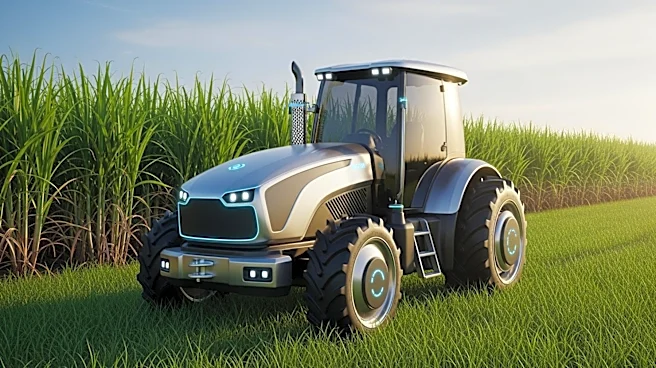
U.S. Sugar has announced the launch of the largest commercial deployment of autonomous tractors in the American sugar industry, marking a significant technological advancement in South Florida's agricultural sector. The company is deploying a fleet of unmanned
John Deere tractors across its 255,000 acres of farmland. These tractors, equipped with Vehicle Automation Kits from Autonomous Solutions, Inc., can operate continuously, 24/7. The technology allows a single operator to manage multiple vehicles from a central command station. U.S. Sugar has committed to retaining its current workforce by providing training for new roles associated with the autonomous fleet. The deployment aims to improve land preparation accuracy, increase production, and enhance sustainability. Over the next decade, U.S. Sugar plans to expand the use of this technology to other crops, such as sweet corn and green beans.
Why It's Important?
The deployment of autonomous tractors by U.S. Sugar represents a major shift towards automation in agriculture, which could significantly impact the industry by increasing efficiency and productivity. This move is expected to enhance the reliability of the domestic food supply and address labor shortages by creating higher-skilled job opportunities. The initiative also aligns with broader trends in agricultural technology, where automation and precision farming are becoming increasingly important for meeting global food demand. By adopting such advanced technologies, U.S. Sugar is setting a precedent for other agricultural companies, potentially leading to widespread adoption of similar technologies across the industry.
What's Next?
U.S. Sugar plans to fully deploy the autonomous technology across its entire 375 square miles of farmland over the next decade. The company also intends to expand the use of autonomous tractors to other crops beyond sugarcane. This expansion could lead to further advancements in agricultural practices and potentially influence policy and investment in agricultural technology. Stakeholders, including other agricultural businesses and policymakers, may closely monitor the outcomes of this deployment to assess its viability and scalability in different agricultural contexts.