




What's Happening?
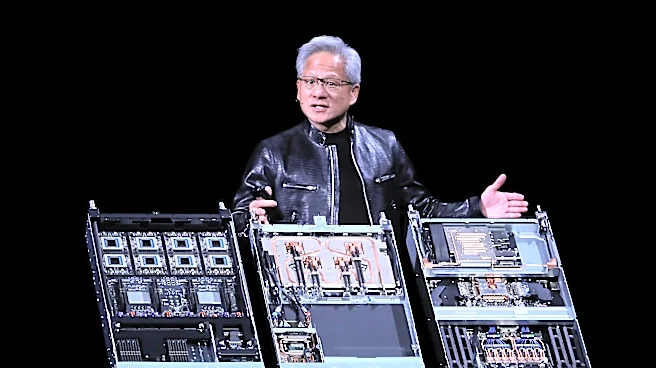
Silicon Valley is rapidly advancing in the field of humanoid robotics, with major players like Nvidia, OpenAI, and Tesla leading the charge. At the recent Nvidia GTC Taipei event, a new standard humanoid robot blueprint was announced, set to be available
for academic researchers by late 2026. This development is part of a broader trend where companies are racing to integrate AI into physical forms that can perform tasks in the real world. Figure AI, a notable startup in this space, has already demonstrated its humanoids in action, sorting packages in a commercial setting. The company has also secured a commercial agreement with Catalyst Brands to deploy these robots in logistics networks. This movement is supported by significant venture capital investment, which has grown from $4 billion in 2019 to $26 billion in 2025.
Why It's Important?
The push towards humanoid robotics represents a significant shift in the AI industry, with the potential to transform various sectors by automating physical tasks. This could lead to increased efficiency in industries such as logistics, manufacturing, and retail, where robots can perform repetitive or dangerous tasks. The economic implications are vast, with Nvidia's CEO Jensen Huang describing it as a 'multitrillion-dollar economic opportunity.' As companies like OpenAI and Meta invest heavily in this technology, the demand for skilled robotics talent is rising, potentially reshaping the job market. However, this also raises questions about the displacement of human workers and the ethical considerations of integrating robots into everyday life.
What's Next?
As the development of humanoid robots progresses, companies are expected to continue investing in research and development to enhance the capabilities of these machines. Tesla's Optimus robot, for example, is anticipated to be available to the public by 2027, with current deployments in Tesla's factories. Hyundai's Boston Dynamics plans to deploy thousands of humanoids in its factories by 2028. The success of these initiatives will likely depend on overcoming technical challenges and gaining public acceptance. Regulatory frameworks may also need to evolve to address the implications of widespread robot deployment.
Beyond the Headlines
The integration of humanoid robots into society could lead to profound cultural and ethical shifts. As robots become more common in workplaces and potentially homes, there will be a need to address issues of privacy, security, and human-robot interaction. The development of 'physical AI' also raises questions about the future of human labor and the potential for increased inequality if certain jobs are automated. Additionally, the environmental impact of producing and operating these robots will need to be considered, as sustainability becomes a growing concern in technology development.