







What's Happening?
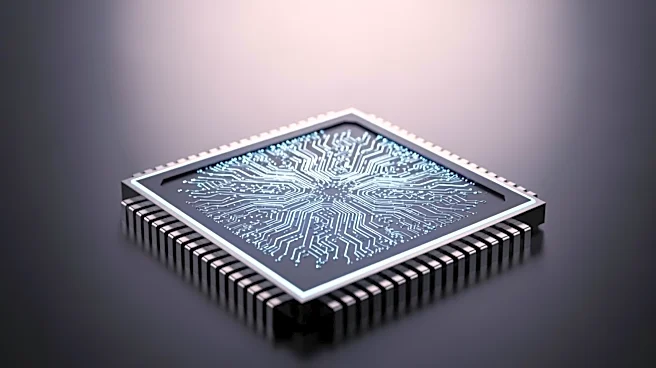
Scientists at the National Institute of Standards and Technology (NIST) have made a significant breakthrough in the development of photonics chips, which could revolutionize quantum technologies. These chips integrate lasers into circuits, allowing for
the manipulation of light in various colors, which is crucial for quantum computers and optical atomic clocks. The new technology involves depositing complex patterns of specialized materials onto silicon wafers, creating circuits that can efficiently route light. This advancement aims to make quantum technologies more affordable and portable, moving them from specialized labs into broader applications.
Why It's Important?
The development of these photonics chips is crucial for the advancement of quantum technologies, which have the potential to transform various industries. Quantum computers, for instance, could revolutionize drug discovery and materials science by providing new ways to study complex systems. Optical atomic clocks, on the other hand, could improve navigation systems and help predict natural disasters. By making these technologies more accessible and cost-effective, the NIST breakthrough could accelerate their integration into practical applications, benefiting sectors such as healthcare, telecommunications, and environmental monitoring.
What's Next?
While the NIST photonics chips are not yet ready for mass production, the techniques developed provide a pathway for scaling up the technology. Collaborations with companies like Octave Photonics are underway to commercialize these advancements. As the technology matures, it is expected to lead to the development of more powerful and efficient AI tools, improved virtual reality displays, and enhanced communication systems. The ongoing research and development efforts will focus on refining the chip fabrication process and expanding its applications across different fields.