
What's Happening?
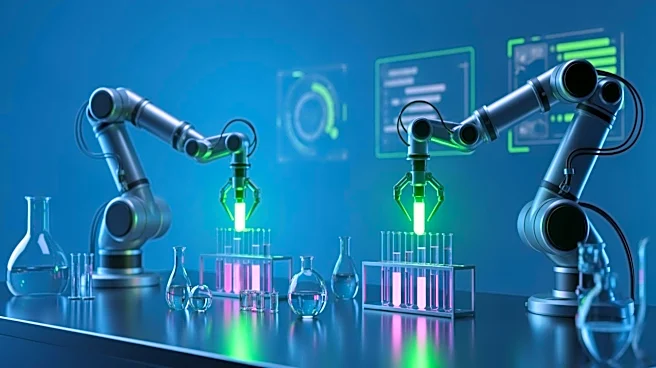
Ginkgo Bioworks, a company founded by MIT graduates, is pioneering the use of AI-powered robots in laboratory settings to automate and enhance scientific research. The company operates an autonomous laboratory in Boston,
where robots perform tasks traditionally handled by human scientists. These robots, which resemble one-armed machines encased in glass, are used for various projects, including engineering microbes for better fertilizers and creating proteins for snow or ice. The integration of AI allows these robots to take over labor-intensive tasks, such as pipetting, which significantly speeds up the research process. The company has also collaborated with OpenAI to further empower robots to design experiments, resulting in a 40% reduction in costs and the completion of over 30,000 experiments in six months.
Why It's Important?
The use of AI and robotics in scientific research represents a significant shift in how experiments are conducted, potentially leading to faster and more cost-effective scientific advancements. This technology could democratize science by allowing more people to engage in research without extensive training. However, it also raises concerns about biosecurity risks, as AI could enable individuals with minimal scientific background to conduct experiments with potentially dangerous outcomes. The potential for misuse underscores the need for regulatory frameworks to manage these risks. The advancements at Ginkgo Bioworks highlight both the promise and the challenges of integrating AI into scientific research, with implications for industries ranging from pharmaceuticals to agriculture.
What's Next?
As Ginkgo Bioworks continues to develop its AI-powered laboratory capabilities, the company may expand its research applications and collaborations. The broader scientific community will likely monitor these developments closely, considering both the technological advancements and the ethical implications. Policymakers and regulatory bodies may need to establish guidelines to ensure the safe and responsible use of AI in scientific research. Additionally, the success of Ginkgo Bioworks could inspire other companies to adopt similar technologies, potentially transforming the landscape of scientific research and innovation.
Beyond the Headlines
The integration of AI in laboratory settings could lead to a cultural shift in the scientific community, where traditional methods are augmented or replaced by automated processes. This shift may challenge existing norms and require scientists to adapt to new roles, focusing more on experimental design and less on manual tasks. The potential for AI to democratize science also raises questions about access and equity, as well as the need for education and training to ensure that a broader range of individuals can participate in scientific inquiry. The ethical considerations surrounding AI in science will likely become a focal point for discussion as these technologies continue to evolve.