



What's Happening?
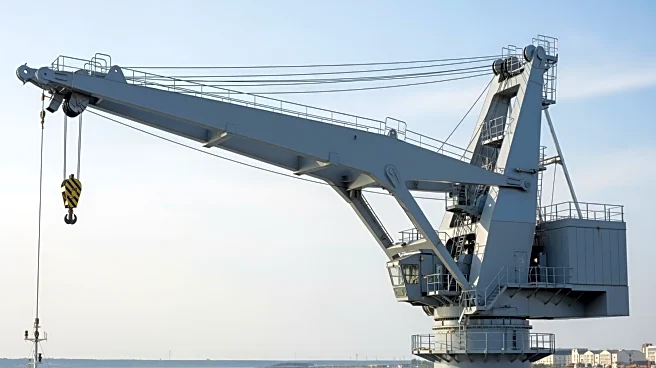
Hartman Seatrade has announced the addition of two Liebherr LS 250 ship cranes to its fleet, enhancing its cargo handling capabilities. These cranes are designed for heavy-duty operations, capable of tandem lifts up to 500 tons, and are engineered to perform
reliably in challenging maritime conditions. The LS 250 cranes feature a lifting capacity of up to 250 tons and a maximum outreach of 36 meters, with a low deadweight of 150 tons to improve vessel stability. The cranes will be installed on new vessels being constructed in Szczecin, Poland, with final outfitting in the Netherlands. The installation process includes a stop in Rostock, Germany, where the cranes are manufactured. The cranes are equipped with Liebherr’s Litronic system, providing precise control and real-time data analysis to optimize performance and safety.
Why It's Important?
The integration of advanced crane technology into Hartman Seatrade's fleet represents a significant enhancement in maritime logistics and cargo handling efficiency. By adopting the LS 250 cranes, the company can offer improved service to its clients, handling larger and more complex cargoes with greater precision and safety. This move also underscores the importance of technological innovation in maintaining competitiveness in the shipping industry. The use of Liebherr’s Litronic system highlights the growing trend towards digitalization and automation in maritime operations, which can lead to increased operational efficiency and reduced human error. As global trade continues to evolve, such advancements are crucial for shipping companies to meet the demands of modern logistics.
What's Next?
The delivery and installation of the LS 250 cranes are scheduled to occur in stages between 2027 and early 2028. During this period, Hartman Seatrade will focus on integrating these cranes into its operations, training staff, and optimizing logistics processes to fully leverage the new capabilities. The company may also explore additional opportunities to expand its fleet and enhance its service offerings. As the maritime industry continues to embrace technological advancements, other shipping companies may follow suit, investing in similar technologies to remain competitive. The successful implementation of these cranes could set a precedent for future innovations in maritime logistics.