
What's Happening?
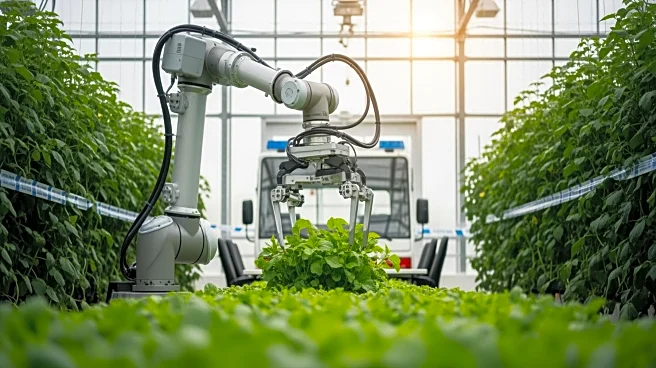
Danish robotics company 4XRobots is expanding its operations into the United States, targeting the commercial greenhouse sector with its collaborative Delta robots. These robots are designed for controlled-environment
agriculture, such as greenhouses, where space is limited and traditional industrial robots are often impractical. The expansion is led by Nick Chambers, head of global market development and insight, who emphasizes the growing demand for automation in horticulture due to labor shortages, rising costs, and operational pressures. The company's robots are designed to work alongside human workers without the need for safety fencing, making them suitable for existing greenhouse operations without requiring major facility changes. 4XRobots has joined the Association for Advancing Automation (A3) to build partnerships with North American robotics integrators and technology partners.
Why It's Important?
The expansion of 4XRobots into the U.S. market is significant as it addresses critical challenges faced by the horticulture industry, including labor shortages and rising operational costs. By providing a flexible and scalable automation solution, the company aims to enhance productivity and efficiency in greenhouse operations. This move could potentially transform the horticulture sector by reducing reliance on seasonal labor and enabling year-round production. The integration of robotics in agriculture also aligns with broader trends towards automation and technological innovation in various industries, potentially setting a precedent for other sectors facing similar challenges.
What's Next?
4XRobots plans to further its presence in North America by building partnerships through the A3 Business Forum, where Chambers will meet with integrators and industry stakeholders. The company aims to demonstrate the applicability of its collaborative Delta robots in greenhouse and horticultural operations, potentially leading to wider adoption across the region. As the technology gains traction, it could prompt other agricultural producers to consider automation solutions, potentially reshaping the labor dynamics and operational strategies within the industry.