
What's Happening?
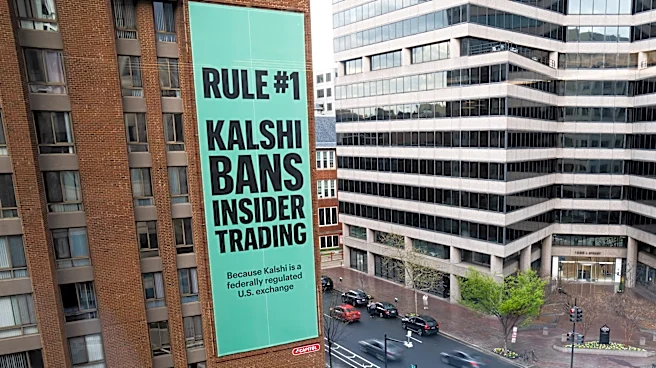
Recent enforcement actions against insider traders in prediction markets have not alleviated concerns among U.S. lawmakers. Democratic Rep. Alexandria Ocasio-Cortez and others have expressed dissatisfaction
with the current state of regulation, despite companies like Kalshi and Polymarket taking steps to address insider trading. Kalshi fined and suspended three congressional candidates for betting on their own elections, while Polymarket flagged a trade involving classified information used by a U.S. Army soldier. Despite these actions, critics argue that prediction markets serve no legitimate purpose and are akin to gambling. Democratic Sen. Chris Murphy and Rep. Greg Casar have introduced legislation to ban prediction markets, citing ethical concerns over gambling on sensitive issues like war and peace.
Why It's Important?
The debate over prediction markets highlights broader concerns about the intersection of finance, ethics, and regulation. Critics argue that these markets could undermine public trust by allowing individuals with insider knowledge to profit unfairly. The legislative push to ban prediction markets reflects a growing unease with their potential to blur the lines between legitimate financial instruments and gambling. This issue also underscores the challenges regulators face in keeping pace with rapidly evolving financial technologies. The outcome of this debate could have significant implications for the future of financial innovation and regulation in the U.S., potentially affecting how similar markets are perceived and managed globally.
What's Next?
As the legislative process unfolds, prediction market companies may face increased scrutiny and pressure to demonstrate their value beyond speculative trading. The proposed ban by Murphy and Casar could gain traction if public sentiment aligns with their concerns. Meanwhile, companies like Kalshi and Polymarket may need to enhance their compliance measures and public relations efforts to counteract negative perceptions. The ongoing legal battles over the classification of these markets as gambling could also influence state-level regulations, potentially leading to a patchwork of laws that complicate operations for these platforms.