


What's Happening?
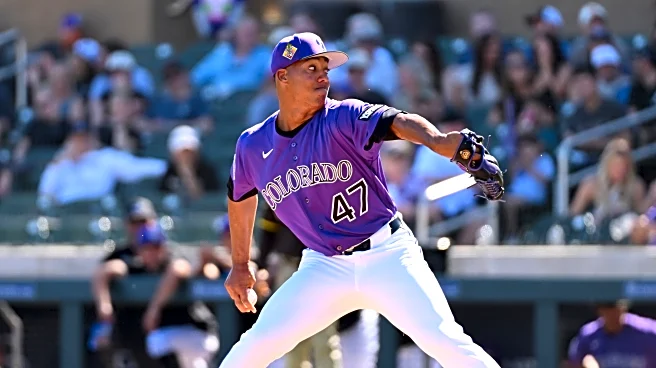
Kyle Freeland, a pitcher for the Colorado Rockies, is set to start on Opening Day for the fifth time in his career. Despite being the franchise's all-time leader in Wins Above Replacement (WAR) among starting pitchers, Freeland's value is often misunderstood
due to the limitations of WAR metrics at Coors Field. The high altitude in Denver affects pitch movement, making it difficult for traditional metrics to accurately assess a pitcher's performance. Freeland's 2018 season exemplifies this issue, where different WAR models rated his performance significantly differently. This discrepancy highlights the challenges of evaluating pitchers in environments like Coors Field, where air density and pitch movement are altered.
Why It's Important?
The discussion around Kyle Freeland's WAR underscores a broader issue in baseball analytics: the difficulty of applying standard metrics to unique environments. Coors Field, known for its hitter-friendly conditions, complicates the evaluation of pitchers who rely on contact management rather than overpowering hitters. This has implications for how teams value and compensate pitchers who perform well in such conditions. Freeland's case suggests that traditional metrics may undervalue pitchers who excel in challenging environments, potentially affecting contract negotiations and team-building strategies. Understanding these nuances is crucial for teams like the Rockies, who must navigate the complexities of pitching at altitude.
What's Next?
As the Rockies prepare for the 2026 season, they face the challenge of building a competitive pitching staff that can succeed at Coors Field. This may involve re-evaluating how they assess and develop pitchers, focusing on skills that are not fully captured by traditional metrics. The team will need to consider how to best support pitchers like Freeland, who have demonstrated the ability to adapt to the unique conditions of their home field. Additionally, the Rockies may advocate for the development of more sophisticated metrics that better account for environmental factors, potentially influencing broader changes in how baseball performance is measured.
Beyond the Headlines
The limitations of WAR at Coors Field raise questions about the fairness and accuracy of player evaluations across Major League Baseball. This issue highlights the need for more context-sensitive metrics that can account for environmental variables. As analytics continue to play a significant role in player evaluation and team strategy, the development of more nuanced metrics could lead to a more equitable assessment of player performance. This could also impact how players are perceived and valued in the broader baseball community, potentially leading to shifts in how talent is scouted and developed.