





What's Happening?
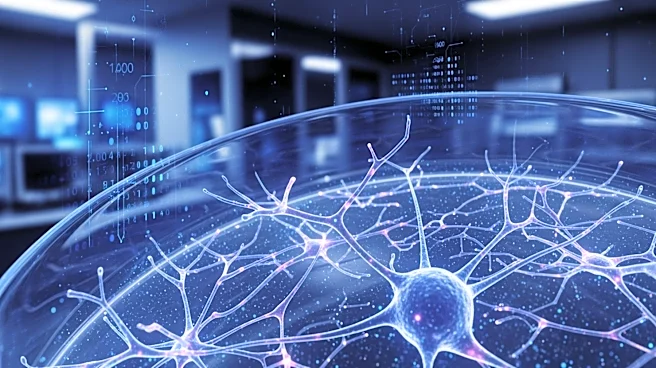
Australian researchers at Cortical Labs have successfully trained lab-grown brain cells to play the 1990s video game 'Doom'. These brain cells, grown from stem cells harvested from blood donations, are integrated into a silicon computer chip, forming
what is referred to as a 'biological computer'. Each chip contains approximately 200,000 living human brain cells. Initially, these neurons were trained to play the simpler game 'Pong', but have now advanced to the more complex 'Doom', which requires navigating a 3D environment and engaging with enemies. The neurons adapt to stimuli in real-time, demonstrating goal-directed learning. The digital environment of 'Doom' is converted into electrical signals that the neurons can interpret, allowing them to react and perform actions such as moving or firing a weapon.
Why It's Important?
This development is significant as it represents a step forward in the field of biocomputing, where biological systems are used to perform computational tasks. The research highlights the potential for these neural cultures to be used in various applications beyond gaming, such as drug screening, AI-like machine learning, and personalized medicine. The efficiency of these biological systems, which operate on significantly less power than traditional silicon-based computing, could lead to more sustainable computing solutions. This could have broad implications for industries reliant on high computational power, offering a more energy-efficient alternative. The ability of these neurons to adapt and learn in real-time also opens up new possibilities for advancements in artificial intelligence and robotics.
What's Next?
The researchers at Cortical Labs plan to explore further applications of their CL1 chip, which could include tasks in robotics, real-time learning, and healthcare. The potential for these neural cultures to perform complex tasks suggests a future where biocomputing could complement or even enhance current AI technologies. However, the current lifespan of the cells is about six months, and they are not yet capable of producing consistent, programmable results. Future research will likely focus on extending the lifespan of these cells and improving their reliability and programmability. The project also aims to address the power consumption challenges faced by traditional computing, potentially leading to more sustainable technology solutions.
Beyond the Headlines
The integration of biological systems into computing raises ethical and philosophical questions about the nature of intelligence and consciousness. As these systems become more advanced, there may be debates about the rights and treatment of lab-grown neural cultures. Additionally, the use of human-derived cells in technology could lead to discussions about privacy and consent. The long-term implications of biocomputing could also influence the development of new regulatory frameworks to address these emerging technologies. As the field progresses, it will be important to consider the societal and ethical impacts of integrating biological systems into everyday technology.