







What's Happening?
Researchers from Waseda University in Japan have developed a novel nanotube membrane-based injector designed to enhance mitochondrial function in cells through cytoplasmic transfer. This innovative system, detailed in a study published in Small Science,
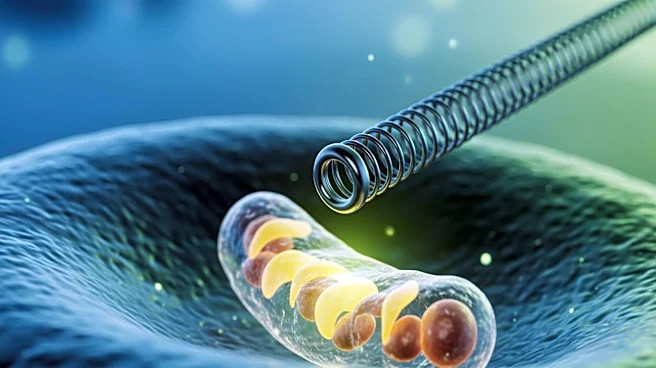
utilizes a thin gold membrane with vertically aligned nanotubes mounted on a glass tube. The nanotubes penetrate the phospholipid bilayer of living cells without causing significant damage, allowing for the transfer of cytoplasmic contents such as proteins, RNA, and mitochondria. The process involves adjusting the internal air pressure of the glass tube to extract cytoplasmic material from source cells and gently flush it into target cells. The researchers confirmed the efficacy of this method through experiments using fluorescent dyes and protein assays, achieving a cytoplasmic transfer efficiency of over 90% while maintaining cell viability at around 95%.
Why It's Important?
This development is significant for the field of regenerative medicine and cell therapy, where maintaining cell viability and function is crucial. The ability to transfer healthy mitochondria or cytoplasmic components into target cells without genetic modification offers a new strategy to improve cell quality prior to transplantation. This could address challenges in regenerative medicine, where therapeutic cells often suffer from reduced metabolic activity or functional heterogeneity. The technology also opens new avenues for cell biology research, bioengineering, and biomedical applications, potentially leading to the development of next-generation cell therapies, improved disease models, and more precise drug screening platforms.
What's Next?
The research team suggests that this technology could transform cell manipulation by reconstructing intracellular composition rather than relying on genetic modification. Future applications may include enhancing the quality of therapeutic cells used in regenerative medicine and developing more accurate disease models. The technology's ability to improve mitochondrial function could also lead to advancements in treating diseases associated with mitochondrial dysfunction. As the system is further refined, it may become a standard tool in laboratories focused on cell therapy and regenerative medicine.