
What's Happening?
ASML Holding N.V., a leading Dutch lithography company, announced record earnings for the first quarter of 2026, driven by a surge in demand for artificial intelligence (AI) infrastructure. The company reported
net sales of €8.8 billion and net income of €2.8 billion, surpassing analyst expectations. This growth is attributed to the widespread adoption of High-Numerical Aperture (High-NA) Extreme Ultraviolet (EUV) lithography systems, which have transitioned from prototypes to high-volume manufacturing tools. ASML's strategic developments over the past few years, including a 'bridge year' in 2024 and capacity expansion in 2025, have positioned it to meet the increasing demand for advanced semiconductor manufacturing. The company's shares rose in pre-market trading, reflecting investor confidence in its growth trajectory.
Why It's Important?
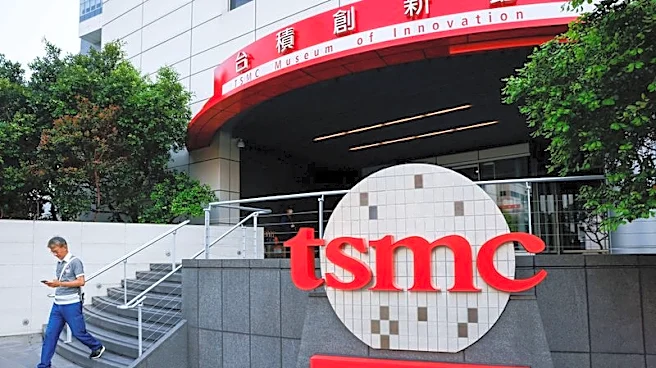
ASML's performance highlights the critical role of advanced lithography in the semiconductor industry, particularly as AI applications drive demand for more sophisticated chips. The company's success underscores the importance of High-NA EUV technology in achieving sub-2nm process nodes, essential for the next generation of AI and computing power. This development has significant implications for major semiconductor players like Intel and Taiwan Semiconductor Manufacturing Co. (TSMC), who are competing to secure ASML's advanced tools. The results also indicate a shift in the geopolitical landscape, with ASML's sales to China stabilizing and growth opportunities expanding in Western markets. The semiconductor equipment sector's growth is pivotal for the digital economy, with ASML at the forefront of this technological arms race.
What's Next?
ASML faces the challenge of meeting the high demand for its lithography systems, with supply constraints expected to persist through 2027. The company has a substantial backlog, placing pressure on its supply chain to deliver on time. Looking ahead, ASML is focusing on developing 'Hyper-NA' lithography, the next generation of technology. The successful ramp-up of 2nm and sub-2nm nodes by 2027 will be crucial for sustaining growth. Investors will be closely monitoring fab utilization rates and yield numbers from major chipmakers like Intel and Samsung. The ongoing geopolitical dynamics and the insatiable demand for computing power will continue to shape the industry's future.