



What's Happening?
Wayve, a UK-based autonomous driving software startup, has successfully raised $1.5 billion in funding, valuing the company at $8.6 billion. This funding round was led by Eclipse Ventures LLC, Balderton Capital, and SoftBank Vision Fund 2, with additional
investments from Ontario Teachers’ Pension Plan, Baillie Gifford, and the British Business Bank. Notably, existing investors such as Microsoft Corp., Nvidia Corp., and Uber Technologies Inc. also participated, with Uber committing an additional $300 million contingent on Wayve achieving specific milestones. Wayve plans to launch self-driving taxis using its software in London this year. The company, founded in 2017 by Cambridge University PhD students, focuses on developing AI that allows vehicles to navigate complex environments without pre-mapped routes. This approach aims to provide flexibility and cost advantages over traditional autonomous vehicle systems.
Why It's Important?
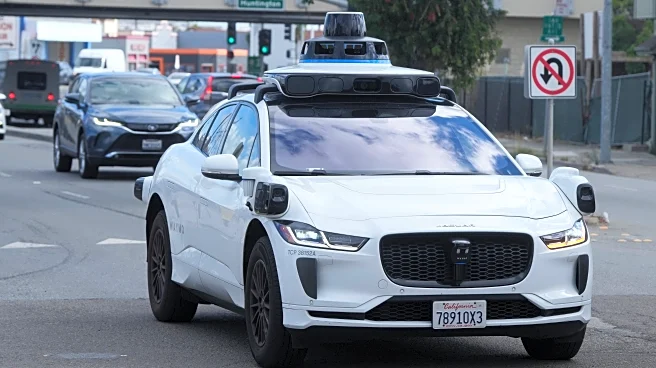
The significant investment in Wayve underscores the growing competition in the autonomous vehicle sector, particularly in the self-driving taxi market. With major players like Waymo and Uber also vying for dominance, Wayve's innovative AI approach could offer a competitive edge by reducing reliance on detailed maps and enabling broader deployment across various cities and vehicle types. This development could accelerate the adoption of autonomous vehicles, potentially transforming urban transportation and reducing reliance on human drivers. The involvement of major investors and tech companies highlights the strategic importance of this technology, which could lead to significant economic and societal impacts, including job shifts and changes in urban planning.
What's Next?
Wayve's next steps involve deploying its self-driving taxis in London and potentially expanding to other cities. The company has partnered with Nissan to integrate its AI technology into the next iteration of Nissan's ProPilot driver assistance system, expected to roll out in 2027. As Wayve continues to test and refine its technology, it will need to navigate regulatory environments and public acceptance challenges. Success in these areas could pave the way for broader adoption of autonomous vehicles, influencing transportation policies and infrastructure development.