


What's Happening?
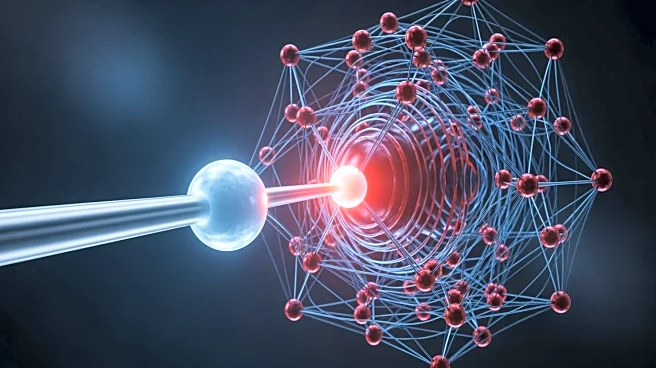
Researchers have developed a machine learning (ML) accelerated workflow to identify liquid-like ion flow in all-solid-state batteries (ASSB), which are considered a safer and more energy-dense alternative to traditional lithium-ion batteries. The performance
of ASSBs is heavily dependent on the rapid movement of ions through solid electrolytes. Traditional methods of identifying materials that facilitate this movement are time-consuming and computationally intensive. The new ML approach simulates Raman spectra, revealing that strong low-frequency Raman intensity is a clear indicator of liquid-like ionic conduction. This method allows for the simulation of vibrational spectra of complex materials at realistic temperatures with high accuracy, significantly reducing computational costs. The findings, published in the journal AI for Science, demonstrate the potential for high-throughput screening of new superionic materials.
Why It's Important?
The development of this ML-accelerated workflow is significant for the advancement of energy storage technologies. By enabling the rapid identification of materials with high ionic mobility, this method could accelerate the development of high-performance solid-state batteries. These batteries are crucial for various applications, including electric vehicles and renewable energy storage, due to their potential for higher energy density and safety compared to traditional lithium-ion batteries. The ability to efficiently screen and identify suitable materials could lead to breakthroughs in battery technology, impacting industries reliant on energy storage solutions. This advancement also highlights the growing role of artificial intelligence in scientific research, particularly in fields requiring complex simulations and data analysis.
What's Next?
The new ML-accelerated Raman pipeline is expected to facilitate further research into advanced battery materials. Researchers can now conduct high-throughput screenings to discover new superionic conductors, potentially leading to the development of more efficient and safer batteries. This method could also be applied to other classes of materials, broadening the scope of energy storage research. As the technology matures, it may attract interest from industries looking to enhance their energy storage capabilities, prompting collaborations between academic institutions and commercial entities. The continued integration of AI in material science research could lead to more rapid innovations and applications in various technological fields.