

What's Happening?
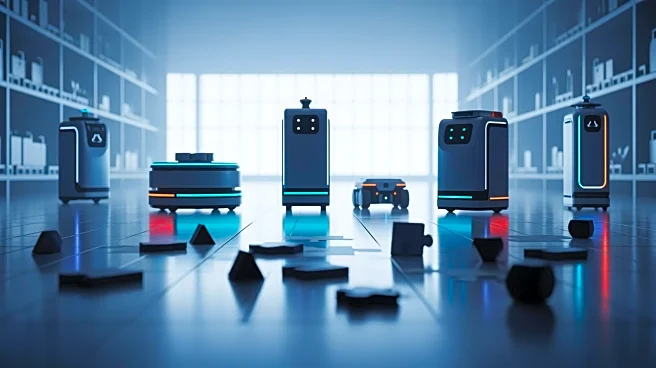
Manufacturers are increasingly turning to Automated Guided Vehicles (AGVs) and Autonomous Mobile Robots (AMRs) to address labor shortages and enhance automation in material movement. However, many of these deployments are failing to deliver the expected
return on investment (ROI). The primary issue lies not with the robots themselves but with the strategic planning phase, where human decision-making processes are often overlooked. In production environments, human workers make dynamic decisions that robots, which operate strictly on pre-programmed instructions, cannot replicate. This gap in decision-making can lead to inefficiencies and the need for frequent human intervention. For instance, a rolled goods manufacturer faced challenges when their AGVs could not dynamically route materials based on real-time demand, highlighting the need for better integration of human logic into automation strategies.
Why It's Important?
The failure to achieve expected ROI from AGV and AMR deployments has significant implications for the manufacturing industry. As companies invest heavily in automation to mitigate labor shortages, the inability to fully capitalize on these technologies can lead to financial losses and operational inefficiencies. The key to overcoming these challenges lies in effectively translating human decision-making into executable logic through orchestration. This involves creating a control layer that integrates robots with other systems, allowing for real-time data exchange and context-aware operations. By addressing these strategic flaws, manufacturers can enhance the efficiency of their automated systems, reduce the need for human intervention, and ultimately achieve the desired ROI from their automation investments.
What's Next?
To improve the success of AGV and AMR deployments, manufacturers need to focus on building a robust deployment strategy that incorporates human decision-making into system logic. This involves implementing an intralogistics platform that provides a centralized environment for coordinating robots, equipment, and enterprise systems. Such a platform allows for the seamless integration of new technologies and workflows, ensuring scalability and sustainability. By adopting this approach, manufacturers can create a cohesive and intelligent operation where robots operate with the same clarity and coordination as human workers, leading to sustained ROI and long-term operational growth.