





What's Happening?
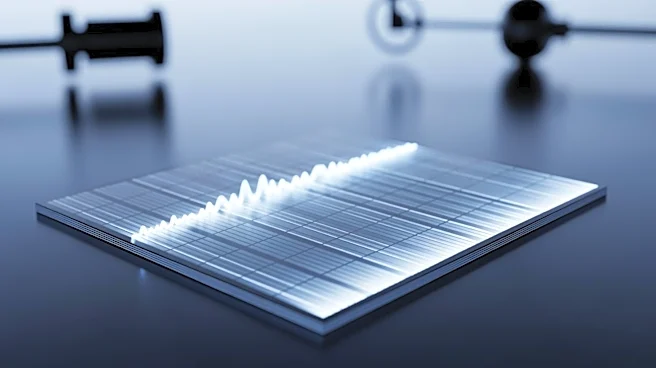
Researchers have developed multifunctional photonic crystals (PhCs) that integrate local and nonlocal optical control. This innovation combines metasurfaces' local wavefront manipulation with PhCs' nonlocal high-Q resonances. The approach involves embedding
meta-notches within PhC pillars, allowing for topological phase encirclement and efficient 2π phase coverage. This integration enables complex field structures and potential applications in analogue optical computing. The design maintains fabrication simplicity while enhancing wave control, offering a unified platform for advanced photonic devices.
Why It's Important?
The development of multifunctional PhCs represents a significant advancement in photonics, potentially impacting various fields such as telecommunications, computing, and imaging. By unifying local and nonlocal optical control, these PhCs offer enhanced functionality and design flexibility. This could lead to more efficient and versatile optical devices, supporting the development of new technologies in data processing and communication. The ability to maintain high-Q resonances while achieving complex wavefront control could drive innovation in optical computing and other applications.
Beyond the Headlines
The integration of local and nonlocal functionalities in PhCs highlights the potential for new optical devices that are robust against fabrication imperfections. This could reduce manufacturing costs and increase the reliability of photonic devices. Additionally, the topological properties of these PhCs may lead to new approaches in optical design, enabling the creation of devices with unique capabilities. The research also underscores the importance of interdisciplinary collaboration in advancing photonic technologies.