



What's Happening?
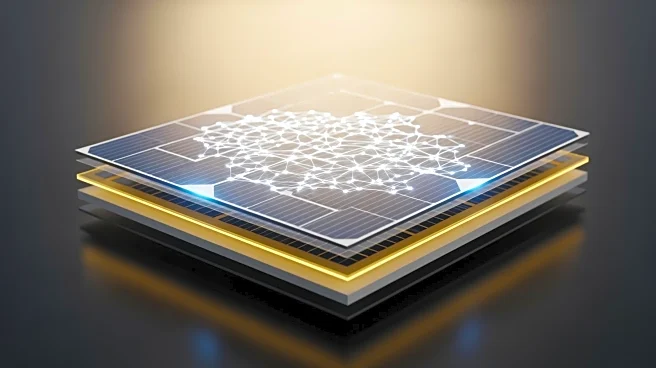
Researchers from the Qingdao Institute of Bioenergy and Bioprocess Technology, part of the Chinese Academy of Sciences, have developed a method to significantly improve the efficiency and stability of perovskite solar cells (PSCs). By engineering a thin two-dimensional perovskite phase at the buried interface of three-dimensional perovskite solar cells, they have achieved a power conversion efficiency (PCE) of 26.19% for small-area devices. This advancement addresses a major challenge in PSCs, which is the presence of defects on the devices' surfaces that limit performance. The team used a novel material, SnO2-TGA-OAm, as a multifunctional electron-transporting layer, which facilitated the formation of a 2D/3D perovskite heterostructure at the film's
bottom interface. This method not only enhances efficiency but also improves the operational stability of the solar cells, making them more viable for commercial applications.
Why It's Important?
The development of more efficient and stable perovskite solar cells is crucial for advancing solar energy technology. Perovskite solar cells are known for their high efficiency and low production costs, but their commercial viability has been hindered by stability issues. The breakthrough achieved by the researchers could accelerate the adoption of perovskite photovoltaics in the energy market, potentially reducing reliance on traditional fossil fuels and contributing to cleaner energy solutions. This advancement could also stimulate further research and development in the field of renewable energy, encouraging investment and innovation in solar technology.
What's Next?
The researchers suggest that their in situ solid-state ligand-exchange strategy could be scaled from laboratory to factory production, paving the way for the commercialization of perovskite solar cells. This could lead to increased production and deployment of high-efficiency solar panels, contributing to global efforts to transition to renewable energy sources. The study's findings may also inspire further research into optimizing the interface engineering of perovskite solar cells, potentially leading to even higher efficiencies and broader applications in the energy sector.