







What's Happening?
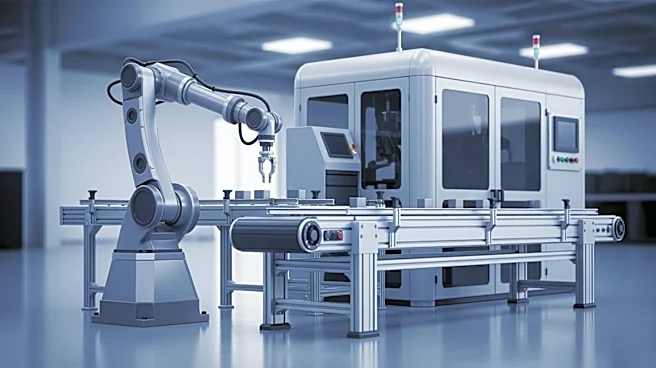
Industrial automation is facing significant challenges due to latency, which is the delay in data transmission between points. This issue is critical in manufacturing environments where operational technology (OT) processes require extremely fast and
consistent communication. Even a delay of 1 millisecond can have substantial production consequences. To address this, engineers are focusing on minimizing protocol conversions, maintaining precise network timing, and using industrial-grade hardware. The integration of private 5G networks and edge computing is also being explored to reduce latency by processing data closer to the machines and processes, rather than relying on remote cloud services. This approach helps in maintaining fast monitoring and analytics, as well as AI-based application responses.
Why It's Important?
The reduction of latency in industrial automation is crucial for maintaining high productivity levels and ensuring the precision of manufacturing tasks. As industries increasingly rely on automation and robotics for tasks such as assembly, welding, and materials handling, the need for real-time decision-making capabilities becomes paramount. By addressing latency issues, manufacturers can enhance the synchronization of industrial robots, leading to improved efficiency and reduced downtime. This has significant implications for the competitiveness of U.S. manufacturing, as it allows for more resilient and responsive production systems. The adoption of advanced technologies like 5G and edge computing could position U.S. industries at the forefront of global manufacturing innovation.
What's Next?
Manufacturers are likely to continue investing in technologies that reduce latency, such as private 5G networks and edge computing solutions. These investments will require collaboration between technology providers and industrial companies to develop robust architectures that integrate seamlessly into existing OT networks. As these technologies become more widespread, there may be increased focus on cybersecurity measures to protect factory networks from external threats. Additionally, ongoing research and development efforts will aim to further decrease latency and enhance the capabilities of industrial automation systems.
Beyond the Headlines
The push to reduce latency in industrial automation highlights broader trends in the integration of digital technologies within traditional manufacturing processes. This shift not only improves efficiency but also raises questions about the future workforce and the skills required to manage increasingly complex automated systems. As automation becomes more prevalent, there may be a growing need for workers skilled in both traditional manufacturing and digital technologies. This could lead to changes in educational and training programs to better prepare the workforce for the evolving industrial landscape.