



What's Happening?
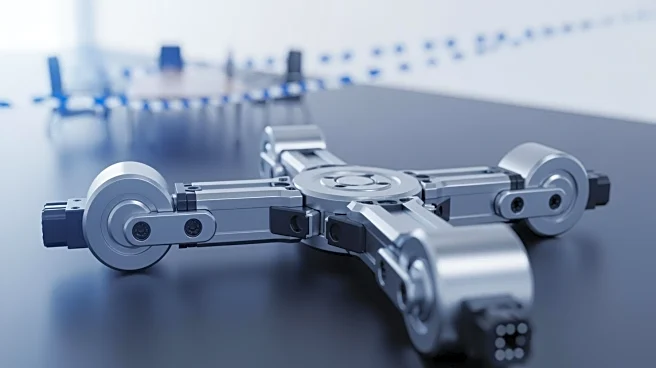
The manufacturing industry is witnessing a shift towards modular robotics as a solution for scalable and adaptable production processes. Unlike traditional fixed automation systems, modular robotics offers flexibility by allowing manufacturers to reconfigure production lines quickly in response to changing market demands. These systems function like industrial Lego blocks, enabling the addition or rearrangement of modules to accommodate new tasks or products. This adaptability is crucial for modern manufacturing, where rapid changes in consumer preferences and technological advancements require agile responses. Modular robotics also reduces downtime and costs associated with reconfiguring traditional systems, making it an attractive option for manufacturers seeking
to future-proof their operations.
Why It's Important?
The adoption of modular robotics in manufacturing represents a paradigm shift towards more flexible and responsive production systems. This approach allows manufacturers to scale operations efficiently, reduce downtime, and manage costs more effectively. By enabling quick adaptation to market changes, modular robotics provides a competitive advantage in an industry where speed and flexibility are increasingly important. The technology also supports the integration of new innovations, such as advanced sensors and AI capabilities, without the need for extensive reconfiguration. As the manufacturing landscape continues to evolve, modular robotics is poised to play a critical role in driving efficiency and innovation.
What's Next?
As modular robotics gains traction, manufacturers will likely invest in developing and implementing these systems to enhance their production capabilities. The technology's success could lead to further advancements in modular design and integration, potentially influencing industry standards and practices. Companies may also explore collaborations with technology providers to expand the functionality of modular systems and address specific production challenges. As the demand for flexible manufacturing solutions grows, modular robotics is expected to become a key component of future production strategies, shaping the industry's evolution and competitiveness.