





What's Happening?
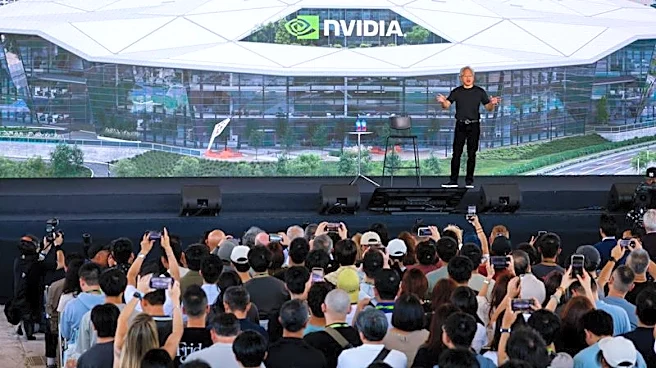
NVIDIA has announced the full production ramp-up of its Vera Rubin platform, designed to power agentic AI factories globally. The platform is being manufactured at scale by leading server makers and supply chain leaders, particularly in Taiwan. Vera Rubin is set
to deliver a tenfold increase in agent throughput compared to its predecessor, the NVIDIA Grace Blackwell platform. The system integrates various NVIDIA technologies, including the Vera CPU, Groq 3 LPX, and BlueField-4 STX storage, into a unified AI supercomputer. The platform also introduces NVIDIA Spectrum-X Ethernet Photonics, which enhances power efficiency and AI uptime. This development is part of NVIDIA's strategy to support the next industrial revolution by providing the infrastructure needed for large-scale AI operations.
Why It's Important?
The launch of the Vera Rubin platform is significant for the AI industry as it promises to enhance the efficiency and scalability of AI factories. By increasing agent throughput and integrating advanced networking technologies, NVIDIA aims to meet the growing demand for AI-driven solutions across various sectors. This development could lead to advancements in AI research and applications, benefiting industries such as cloud computing, data analysis, and autonomous systems. The platform's focus on security and efficiency also addresses concerns about data protection and operational costs, making it an attractive option for enterprises looking to scale their AI capabilities.
What's Next?
Production shipments of the Vera Rubin platform are expected to begin in the fall. As the platform becomes available, it is likely to be adopted by major cloud providers and technology companies, further expanding its impact on the AI industry. NVIDIA's continued investment in AI infrastructure suggests that the company will remain a key player in shaping the future of AI technology. The success of the Vera Rubin platform could also influence other tech companies to develop similar solutions, potentially leading to increased competition and innovation in the AI sector.