








What's Happening?
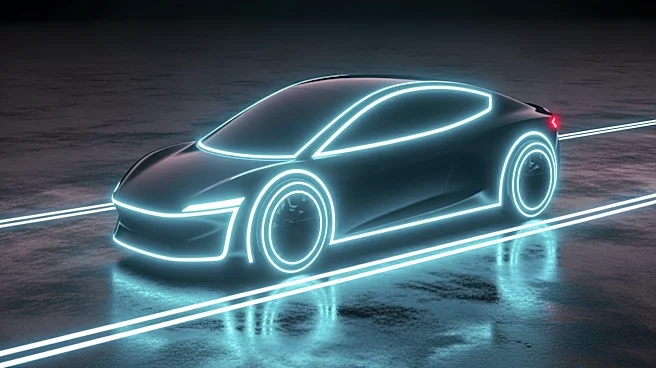
Mercedes-Benz has been at the forefront of using turquoise lights to indicate when a vehicle's autonomous driving systems are active. This initiative began in the United States, where Mercedes tested these lights on its Level 3 autonomous systems in California
and Nevada. The choice of turquoise is strategic, as it does not conflict with other vehicle lights or traffic signals, and is easily recognizable by other road users. General Motors is also adopting this approach for its Escalade IQ, incorporating turquoise lights into its autonomous driving suite. In China, the use of these lights is rapidly expanding, with plans to make them compulsory for vehicles equipped with Level 2, 3, and 4 autonomous systems. This move aims to clearly signal to other drivers and law enforcement when a vehicle is operating autonomously.
Why It's Important?
The adoption of turquoise lights for autonomous vehicles is significant as it represents a shift in how road safety and communication are managed in the era of self-driving technology. By clearly indicating when a vehicle is in autonomous mode, these lights can help reduce confusion and improve safety on the roads. This development is particularly important as more vehicles with advanced driver-assistance systems (ADAS) become common. The move by China to mandate these lights could set a precedent for other countries, potentially leading to a global standard. This could benefit manufacturers by providing a consistent framework for autonomous vehicle signaling, while also enhancing public trust and acceptance of self-driving technology.
What's Next?
As China moves towards mandating turquoise lights for autonomous vehicles, it is likely that other countries will observe the outcomes and consider similar regulations. This could lead to international standards for autonomous vehicle signaling, facilitating smoother integration of these technologies worldwide. Automakers may need to adapt their designs to comply with these standards, potentially influencing the development and deployment of autonomous vehicles globally. Additionally, public education campaigns may be necessary to inform drivers about the significance of these lights and how to interact with autonomous vehicles on the road.