






What's Happening?
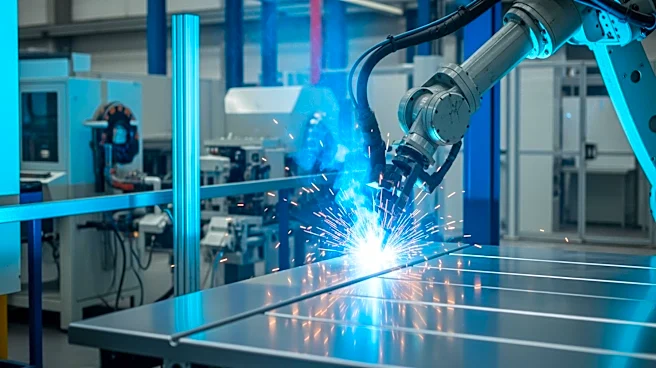
Dextall, a New York-based facade manufacturer, has introduced a proprietary robotic welding platform that significantly increases the production speed of structural components. The company claims that this innovation triples the speed of high-rise fabrication,
not through advanced engineering, but by simplifying its supply chain. By consolidating five distinct structural steel hook configurations into a single standardized component, Dextall has achieved the volume stability necessary for economically viable automation. The company is collaborating with industry leaders such as Turner Construction and Suffolk Construction, and its 'standardize-first' methodology is seen as a blueprint for scaling construction technology amid labor shortages and rising material costs.
Why It's Important?
The introduction of Dextall's robotic welding platform is a significant development in the construction industry, particularly in the context of labor shortages and increasing material costs. By automating the production of structural components, Dextall can meet growing demand while controlling production costs and ensuring consistent quality. This shift from experimental pilot programs to high-output production infrastructure represents a broader trend in the construction sector towards automation. The ability to produce components at three times the speed of manual welding offers a competitive advantage, potentially transforming the industry by setting new standards for efficiency and reliability.
What's Next?
Dextall plans to expand its methodology across its entire component library, aiming to automate the production of facade components. This move is expected to further enhance its ability to meet accelerating demand while maintaining cost efficiency and quality. As the company continues to standardize its components, it may influence other construction firms to adopt similar automation strategies. The success of Dextall's approach could lead to increased investment in robotic technologies within the construction sector, potentially reshaping industry practices and standards.