







What's Happening?
Muon Space, a Silicon Valley-based company, is significantly expanding its workforce following a series of high-value defense contracts and a $146 million Series B funding round. The company is shifting from bespoke satellite missions to mass-scale constellation
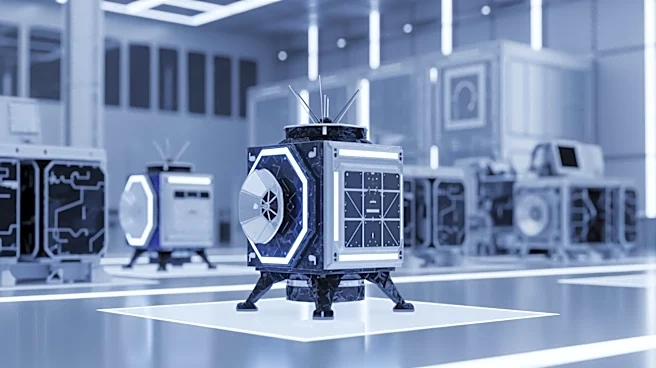
production, supported by a new 130,000-square-foot facility in San Jose capable of producing up to 500 satellites annually. This expansion is part of Muon Space's 'Mission Foundry' model, which automates the workflow to deliver operational outcomes rather than just hardware. The company has been integrated into the U.S. military's proliferated satellite architectures and has secured a $44.6 million SBIR Phase III contract from the U.S. Space Force to develop Space-Based Environmental Monitoring prototypes. These developments are part of Muon Space's strategy to meet the rigorous requirements of its 20-satellite launch manifest over the next 20 months.
Why It's Important?
The expansion of Muon Space is significant for the U.S. defense and space sectors, as it enhances the country's capabilities in satellite production and space-based environmental monitoring. By transitioning to mass-scale production, Muon Space is poised to meet the growing demand for satellite-based data services, which are crucial for military and intelligence operations. The company's integration into the U.S. military's satellite architectures underscores its strategic importance in national defense. Additionally, the development of Space-Based Environmental Monitoring prototypes will provide critical weather imagery and cloud characterization, supporting tactical planning in contested environments. This expansion not only strengthens the U.S. position in space technology but also creates job opportunities and stimulates economic growth in the tech sector.
What's Next?
Muon Space plans to continue its hiring surge through late 2026 as it prepares for its first orbital tests of persistent optical connectivity via the Starlink network in 2027. The company is also set to deploy the SNC Vindlér 2.0 constellation for radio-frequency analytics and three additional FireSats for the Earth Fire Alliance. These developments indicate a robust pipeline of projects that will further solidify Muon Space's role in the space industry. The integration of SpaceX Starlink mini-laser terminals, scheduled to begin in Q3 2026, will enhance the company's connectivity capabilities, making it a key player in the provision of high-cadence environmental and intelligence data.