



What's Happening?
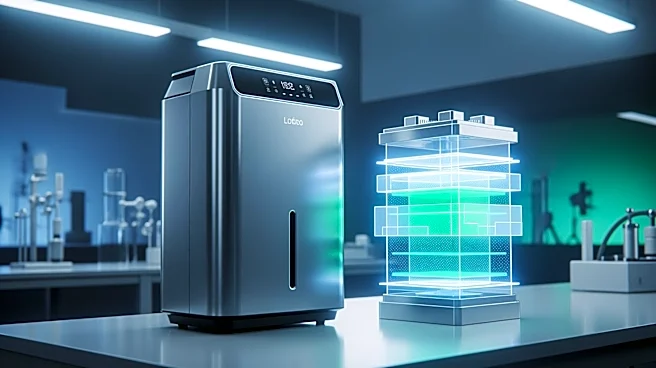
CK Solution has announced the development of a new dehumidifier system, the 'Dry Monster (CDHL-4500),' specifically designed for solid-state battery manufacturing. This system is optimized for environments that require significantly lower humidity levels
than those needed for conventional lithium-ion batteries. The Dry Monster features two dehumidification rotors, each with a diameter of 4.5 meters, which the company claims are the largest of their kind. This system can handle up to 115,000 cubic meters of airflow per hour, which is approximately 2.4 times more than existing models. The increased capacity allows manufacturers to reduce the number of units needed, cutting machinery room space by up to 30% and maintaining operating costs at current levels. CK Solution holds exclusive domestic supply rights in Korea for dehumidification rotors from Japan-based Nichias Corporation and is in talks with major battery manufacturers for supply agreements.
Why It's Important?
The development of the Dry Monster dehumidifier by CK Solution is significant for the solid-state battery industry, which is poised to become a major player in the energy storage market. Solid-state batteries offer advantages over traditional lithium-ion batteries, such as higher energy density and improved safety. However, they require more stringent environmental controls during production, particularly in terms of humidity. By reducing the number of dehumidification units needed and the associated costs, CK Solution's innovation could lower the barriers to entry for manufacturers, potentially accelerating the adoption of solid-state batteries. This could have a ripple effect on industries reliant on battery technology, including electric vehicles and renewable energy storage, thereby influencing the broader energy landscape.
What's Next?
CK Solution is currently in discussions with several major battery manufacturers in Korea and internationally to supply its new dehumidifier systems. As these negotiations progress, the company may secure significant contracts that could expand its market presence and influence in the battery manufacturing sector. Additionally, the successful implementation of this technology could prompt other companies to innovate similar solutions, further advancing the solid-state battery industry. The outcome of these discussions and the subsequent adoption of the Dry Monster system will be critical in determining the pace at which solid-state battery technology can be scaled and commercialized.