


What's Happening?
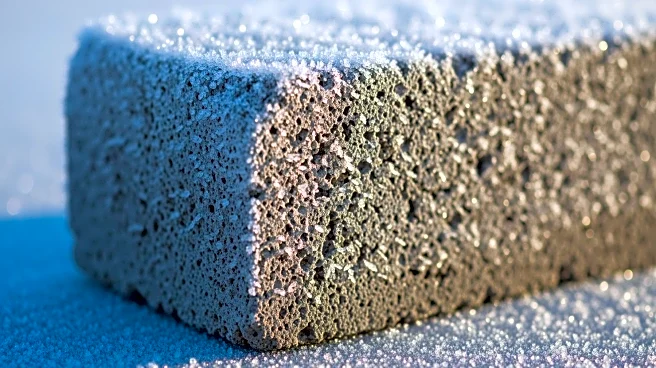
A recent study published in Scientific Reports has demonstrated that incorporating nano-alumina into concrete significantly enhances its strength, durability, and structural integrity. The research focused on the use of high-shear mixing to disperse nano-alumina particles within the concrete, which resulted in a denser and more cohesive material. This method addresses traditional weaknesses in concrete, such as brittleness and reduced durability under extreme conditions. The study tested various dosages of nano-alumina and found that higher concentrations led to substantial improvements in compressive, tensile, and flexural strength. Additionally, the modified concrete showed increased resistance to chemical exposure, freeze-thaw cycles, and high temperatures,
making it suitable for infrastructure in challenging environments.
Why It's Important?
The findings of this study have significant implications for the construction industry, particularly in the development of infrastructure that can withstand mechanical, chemical, and thermal stress. By enhancing the durability and strength of concrete, this technology could lead to longer-lasting structures with reduced maintenance needs, indirectly supporting environmental sustainability goals. The use of high-shear mixing as a cost-effective and scalable method for dispersing nano-alumina also makes this advancement feasible for real-world applications. This could revolutionize construction practices, especially in areas prone to harsh environmental conditions, by providing a more resilient building material.
What's Next?
Future research is expected to focus on refining the incorporation and mixing techniques of nano-alumina in concrete. There is also potential for exploring hybrid nanoparticle systems and evaluating the field performance of these materials under real-world conditions. Additionally, assessing the cost-effectiveness and sustainability impact of using nano-alumina in construction could further support its adoption in the industry. As the technology develops, it may lead to smarter, longer-lasting, and more resilient construction materials, paving the way for advancements in modern infrastructure.