



What's Happening?
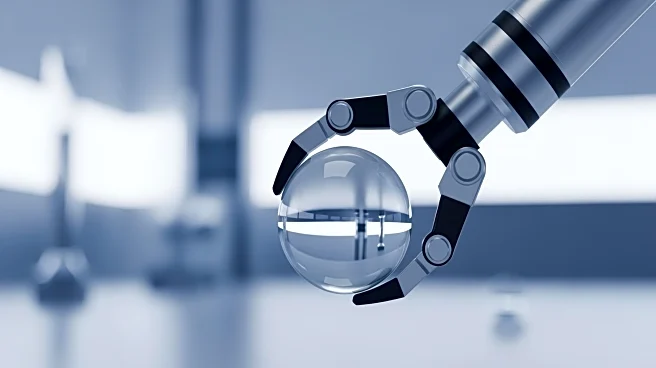
Researchers from Tokyo University of Science have introduced a new robotic vision system called HEAPGrasp, designed to improve the ability of robots to grasp objects with challenging optical properties, such as transparency and reflectivity. The system utilizes
a single RGB camera to capture images from multiple viewpoints, employing a technique known as Shape from Silhouette (SfS) to reconstruct the 3D shape of objects. This method allows robots to accurately identify and handle objects that are typically difficult for conventional 3D measurement systems. The HEAPGrasp system achieved a 96% success rate in grasping tests, outperforming existing methods and reducing the camera's trajectory length and execution time significantly.
Why It's Important?
The development of HEAPGrasp represents a significant advancement in robotic automation, particularly in industries such as manufacturing and logistics where handling diverse materials is crucial. By enabling robots to autonomously manage objects with complex optical properties, the system reduces the need for human intervention, thereby increasing efficiency and safety in workplaces. This innovation could lead to broader applications of robotics in various sectors, enhancing productivity and reducing operational costs. The ability to retrofit HEAPGrasp to existing systems further underscores its potential impact on the industry.
What's Next?
The HEAPGrasp system is set to be presented at the 2026 IEEE International Conference on Robotics and Automation, which could lead to further collaborations and developments in the field. As industries continue to adopt automation, the integration of such advanced systems could become more widespread, prompting further research and development to refine and expand the capabilities of robotic systems. Stakeholders in the robotics industry may explore partnerships to commercialize this technology, potentially leading to new market opportunities and advancements in robotic applications.