


What's Happening?
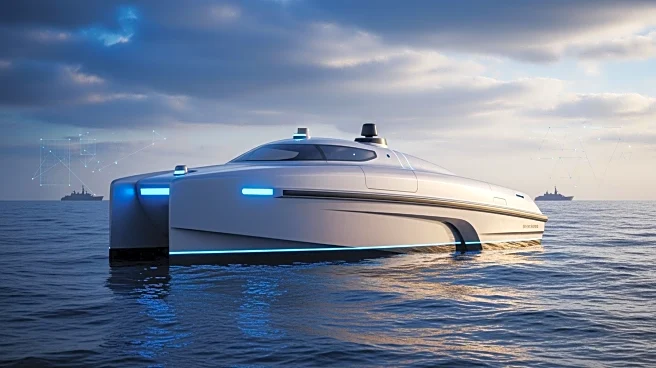
Blue Water Autonomy, a Boston-based company, is advancing its 190-foot robotic patrol craft from prototype to production, highlighting a competitive field of unmanned surface vessel (USV) manufacturers vying for U.S. Navy contracts. The Navy is exploring the integration of medium and large USVs into its fleet, with ongoing experimental initiatives under three commands. The effectiveness of these vessels has been demonstrated in real-world scenarios, such as the Ukraine conflict, suggesting their potential as deterrents against threats like China. Companies ranging from industrial giants like HII and Leidos to smaller firms like HavocAI and Saildrone are presenting their USV designs. Admiral Daryl Caudle, Chief of Naval Operations, emphasizes
the need for alignment between acquisitions and the Navy's operational strategies to avoid bottlenecks. The Navy's procurement focus is shifting towards larger USVs, with plans for a fleet of 381 manned and 134 unmanned vessels, supported by a $2.1 billion Congressional allocation for medium USVs.
Why It's Important?
The competition among USV manufacturers is crucial as the U.S. Navy seeks to enhance its maritime capabilities amid escalating global threats, particularly from China. The integration of USVs could significantly bolster the Navy's strategic advantage in the Pacific theater, providing a cost-effective means to deploy firepower and capabilities at sea. The shift towards larger USVs reflects a broader trend in military procurement, emphasizing the need for advanced unmanned platforms capable of carrying munitions. This development could lead to increased private sector investment and innovation in the defense industry, as companies strive to meet the Navy's evolving requirements. The successful integration of USVs into the Navy's fleet could redefine naval warfare, offering new tactical options and enhancing the U.S.'s ability to project power globally.
What's Next?
The Navy's Modular Attack Surface Craft (MASC) program is expected to be a focal point for future USV capabilities, with designs accommodating various payloads and enhancing operational versatility. The first delivery of Blue Water's Liberty class vessel is anticipated later this year, marking a significant milestone in the production of autonomous maritime systems. As the Navy continues to refine its USV strategy, companies will need to adapt to the competitive dynamics of the defense marketplace, balancing innovation with operational readiness. The outcome of this competition will likely shape the future of naval operations, influencing procurement decisions and strategic planning for years to come.