



What's Happening?
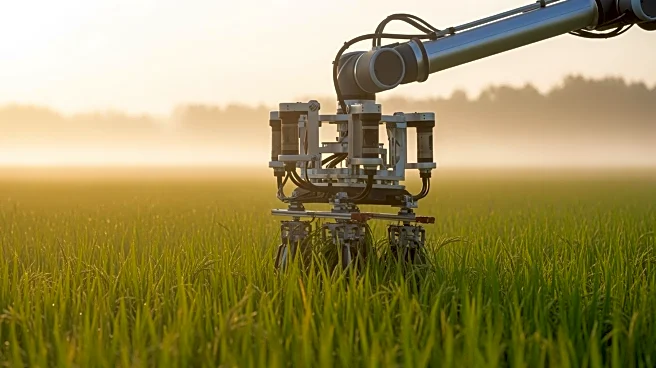
A recent review highlights the rapid advancements in robotic weed management for rice cultivation, focusing on AI, sensor fusion, and amphibious platforms. The review, published in the Journal of Agriculture and Food Research, analyzes 191 scientific
publications and emphasizes the challenges of deploying robotics in paddy fields, which are characterized by water, mud, and plant overlap. Current robotic systems often struggle with detection reliability under these conditions. The review suggests that future innovations should focus on sensor fusion, edge AI, and amphibious platforms to improve performance. The integration of these technologies aims to enhance precision, reduce herbicide use, and increase labor efficiency in rice production.
Why It's Important?
The development of advanced robotic weed management systems is crucial for the agricultural sector, particularly in rice cultivation, which presents unique environmental challenges. By improving detection reliability and operational efficiency, these technologies have the potential to significantly reduce herbicide use and labor costs, contributing to more sustainable farming practices. The successful integration of AI and sensor fusion in these systems could lead to broader adoption and set new standards for precision agriculture. This advancement not only benefits rice producers but also has implications for global food security and environmental sustainability.